From Hanoi to Bucharest: A Vietnamese Cello Journey
Table of Contents
- 1. Why Hanoi to Bucharest Is a Vietnamese Cello Journey
- 2. From Age Ten to Bucharest: Dinh Hoai Xuan’s Artistic Formation
- 3. Cello Fundamento: Turning Cello Performance Into Cultural Connection
- 4. The Vietnam–Romania Friendship Concert at the Romanian Athenaeum
- 5. Who Performs: The Bucharest Symphony Orchestra, Conductors and Featured Artists
- 6. How the Concert Moves From Vietnamese Identity to Shared Repertoire
- 7. Concert Program: Thirteen Works in a 69-Minute Arc
- 8. Why the Collaboration Matters Beyond One Concert
- 9. How Audiences Can Experience the Journey Responsibly
- 10. Frequently Asked Questions About the Hanoi–Bucharest Cello Journey
Why Hanoi to Bucharest Is a Vietnamese Cello Journey
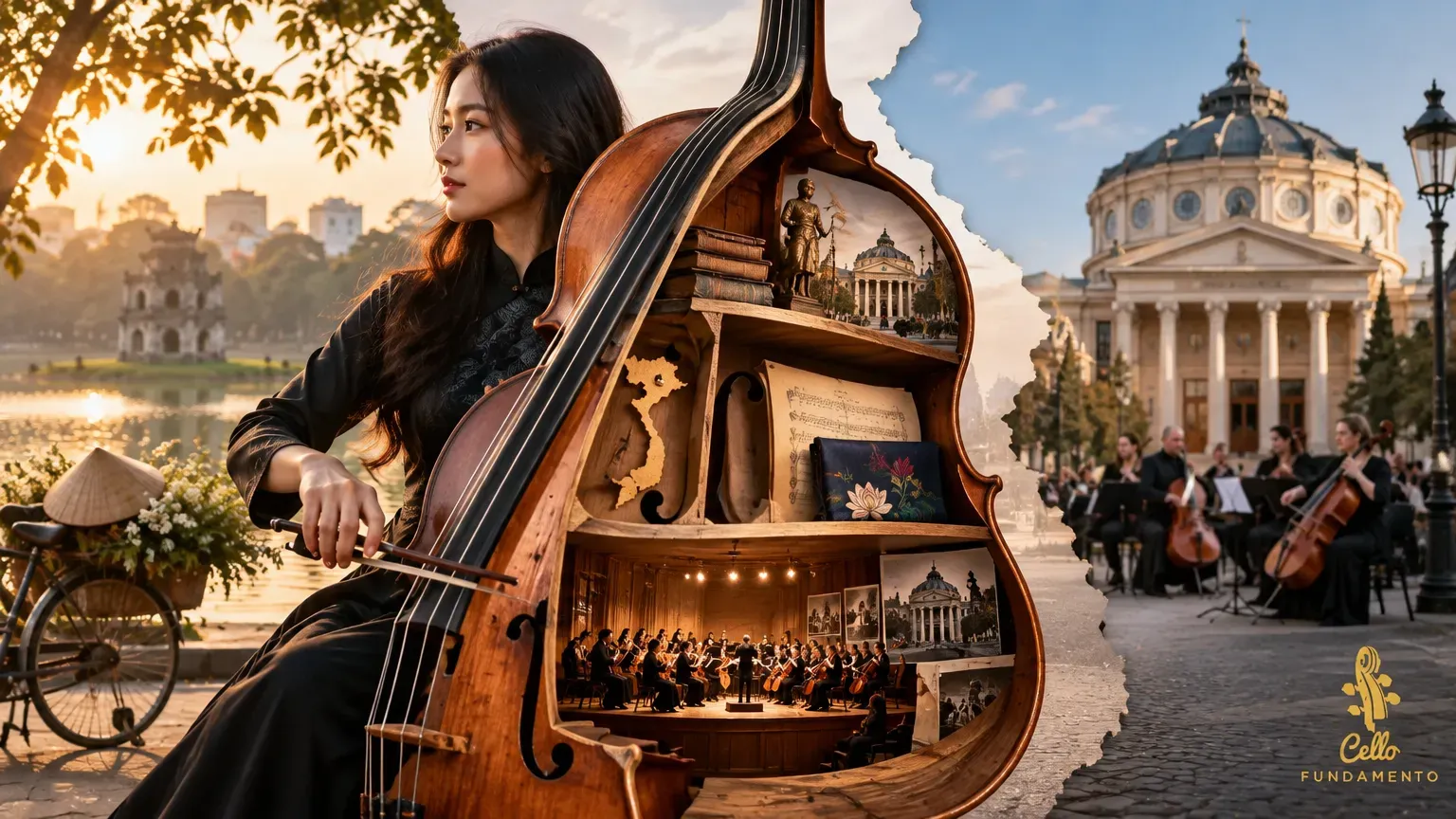
From Hanoi to Bucharest: A Vietnamese cello journey is not simply a route between two capitals. It describes an artistic path shaped by Vietnamese musical memory, professional study in Romania, and a continuing effort to make classical music feel open rather than distant.
For cellist Đinh Hoài Xuân, Hanoi represents a living cultural horizon: Vietnamese songs, audiences, schools, and the community work that has grown around Cello Fundamento. Bucharest represents a formative chapter of advanced study and international collaboration. The journey between them is therefore both geographical and musical. It places a Vietnamese artist within the classical-music world without asking her to leave Vietnamese repertoire behind.
The Vietnam–Romania Friendship Concert makes that connection audible. Its program moves among Vietnamese homeland songs, a Romanian cello-quartet work, Mozart, Romanian vocal repertoire, and an Italian song, performed by artists from Vietnam and Romania alongside the Bucharest Symphony Orchestra. This is not evidence that the two traditions are identical. Rather, it is a curated meeting of distinct musical languages, performers, and audiences.
For Vietnamese people living abroad, that meeting may carry a particular resonance. A familiar title about Hanoi or homeland can become a point of recognition inside an international concert hall. The cello’s voice does not replace the original identity of a song; through arrangement, it offers another way to hear it—at once intimate, orchestral, and mobile across borders.
From Age Ten to Bucharest: Dinh Hoai Xuan’s Artistic Formation
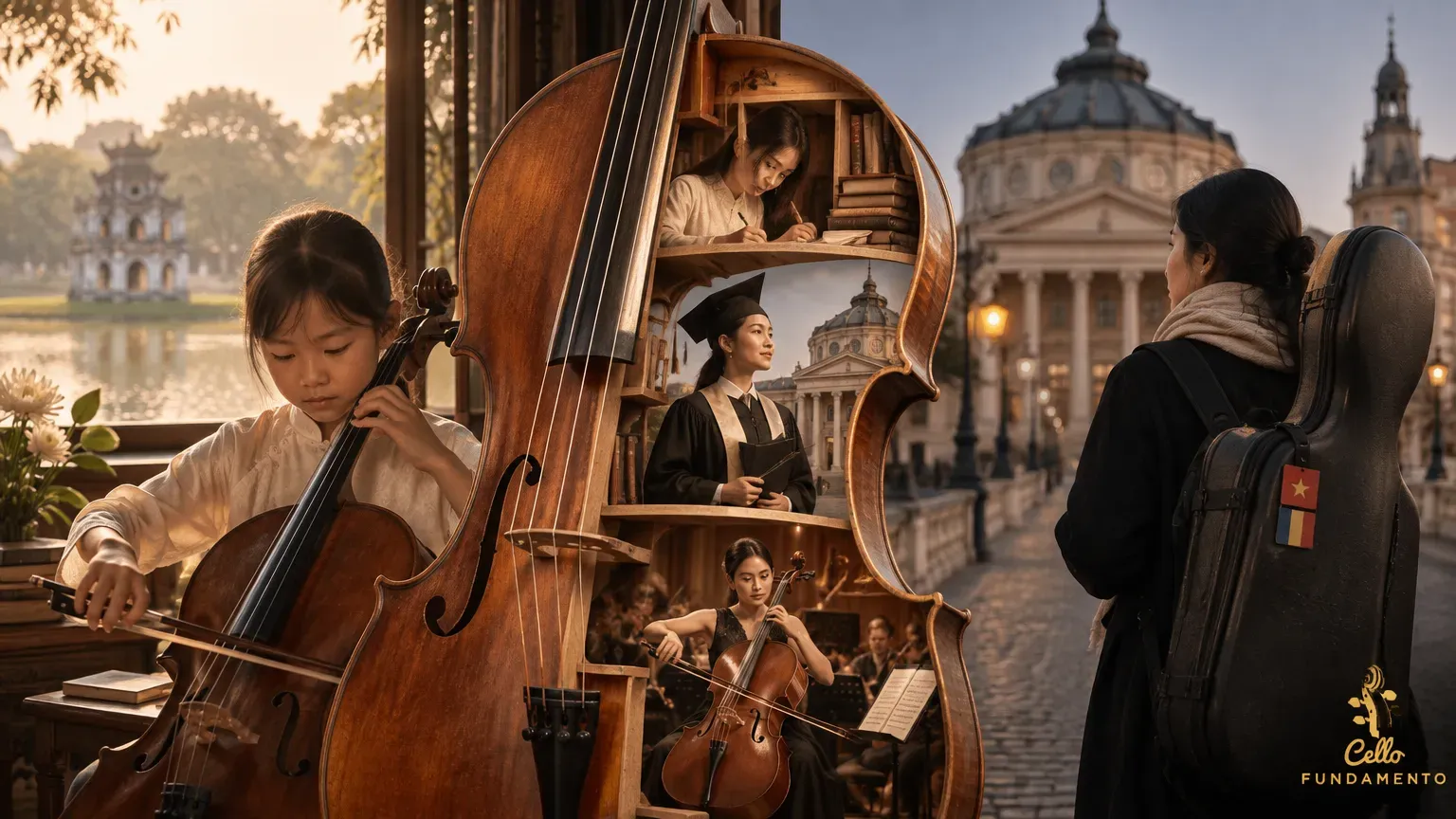
Đinh Hoài Xuân began professional musical training at the age of ten. That early start matters because the cello requires a long relationship between physical technique, listening, ensemble awareness, and interpretive judgment. Her later work as a performer and cultural organizer rests on that sustained training rather than on a sudden crossover into classical music.
She graduated as valedictorian from the Hue Academy of Music, a milestone that placed her within Vietnam’s formal music-education tradition. She subsequently received scholarships from the governments of Vietnam and Romania to study cello performance at the National University of Music Bucharest. The move to Bucharest was therefore not merely an overseas engagement; it was part of a documented educational path supported by both countries.
At the National University of Music Bucharest, she continued developing as a cellist in a city with its own conservatory and orchestral culture. In 2019, she successfully defended her doctoral dissertation and became Vietnam’s first female Doctor of Cello, according to the supplied Cello Fundamento materials. This academic achievement adds an important dimension to her public work: performance, research, and music education are connected rather than separate pursuits.
Her biography should not be reduced to a simple “East meets West” narrative. Vietnamese training, study in Romania, and later international collaborations are distinct experiences with different institutional settings. Together, however, they help explain why her concert work can place Vietnamese melodies beside European repertoire with care for arrangement, instrumentation, and context.
The Hanoi-to-Bucharest arc also helps audiences understand the perspective behind Cello Fundamento. It is led by an artist who has worked across national settings while continuing to bring the cello and classical music toward Vietnamese listeners, especially younger people. The resulting artistic identity is international in scope without treating Vietnam as background material.
Cello Fundamento: Turning Cello Performance Into Cultural Connection
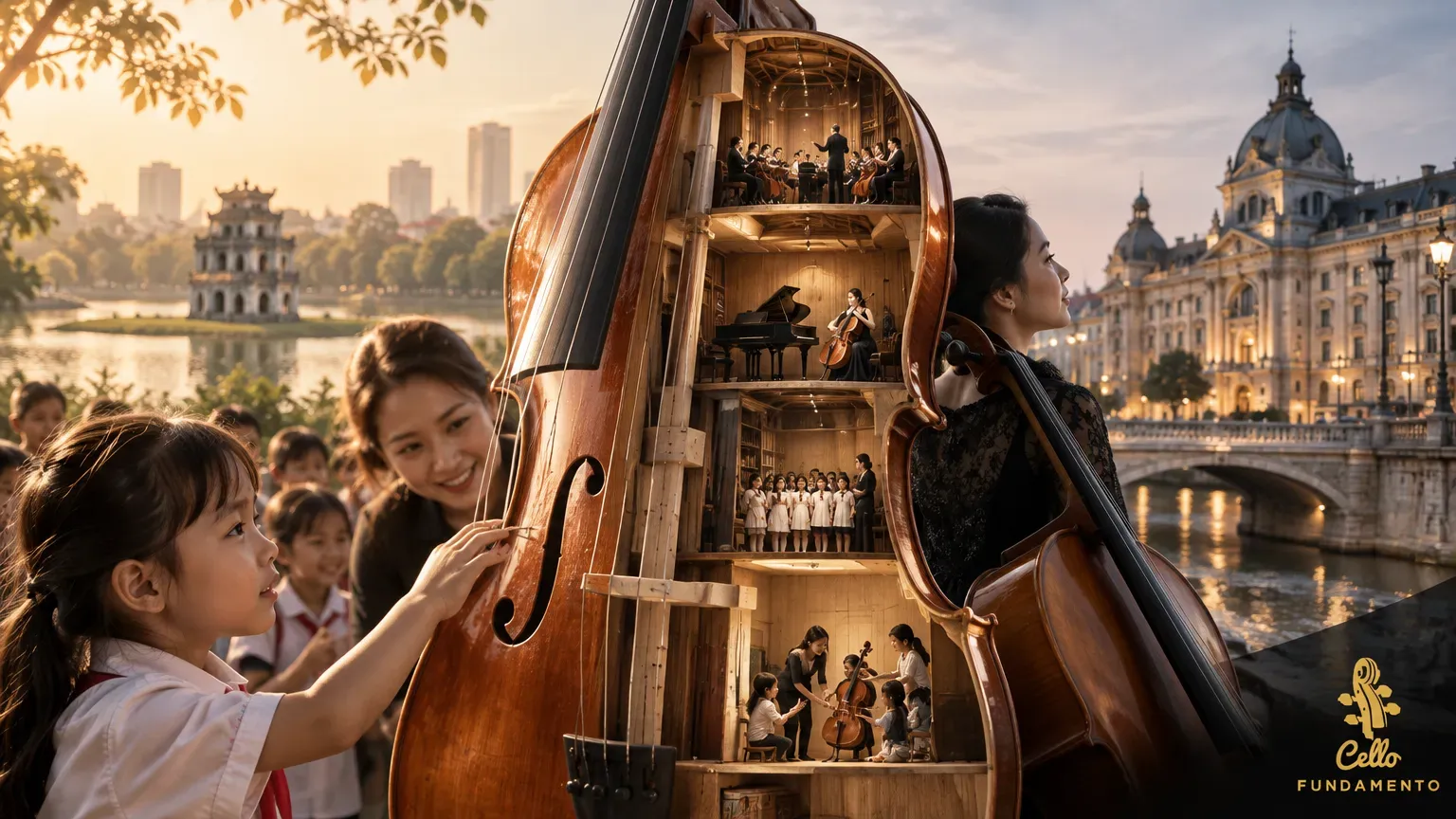
Founded by Đinh Hoài Xuân in 2016, Cello Fundamento began as an annual classical concert series with a clear purpose: to bring symphonic and classical music closer to Vietnamese audiences. Its programs place the cello in conversation with piano, violin, orchestra, voices, and other instruments, showing the instrument as both an orchestral foundation and a compelling solo voice.
The series has also made space for Vietnamese songs in newly arranged classical settings. That approach is significant because an arrangement is not simply a decorative rewrite. It determines which instrument carries a melody, how rhythm is framed, where an orchestra enters, and how a familiar song can inhabit a concert setting without losing its core character.
In 2023, Cello Fundamento formally became a social enterprise in Hanoi. Its stated mission is to bring classical music closer to the community, particularly children and young people. Alongside concerts, its activities include the Cello Fundamento scholarship fund and educational outreach through One Million Hands Touch Cello, also known as CF to School: Millionhands’ Cello.
That outreach initiative brings performances and music-education activities to schools. Cello Fundamento reports that the project has reached 300,000 young people through its journey from Huế to schools across central Vietnam, the Central Highlands, and Hanoi. The larger goal—one million hands touching the cello—is aspirational, not a completed total.
This context changes how the Bucharest concert can be understood. It is a high-profile international performance, but it also belongs to a longer effort to make classical music socially reachable. Cultural connection here is created through programming, education, and repeated encounters with an instrument that some audiences may otherwise only meet at a distance.
The Vietnam–Romania Friendship Concert at the Romanian Athenaeum
The Vietnam–Romania Friendship Concert, presented as Cello Fundamento 12, is scheduled for 7:00 PM on Tuesday, August 18, 2026, at the Romanian Athenaeum in Bucharest, Romania. The listed time is Bucharest local time. Its venue gives the event a prominent concert-hall setting for a program built around Vietnamese, Romanian, and wider international repertoire.
The Bucharest Symphony Orchestra is the main performing orchestra. The event is designed as a non-stop concert, with no intermission. Its net performance time is expected to be approximately 69 minutes. The full event is expected to run about 80 minutes once brief master of ceremonies introductions, applause, and two short remarks from the respective ambassadors are included.
This distinction between performance duration and event duration is useful for audiences planning an evening at the Athenaeum. The 69-minute figure refers to the music itself; it does not mean that guests should expect to leave exactly 69 minutes after the scheduled start.
The concert’s title signals friendship and cultural exchange, but audiences should avoid assuming it represents a full history of Vietnam–Romania relations. The confirmed facts are more specific: Vietnamese and Romanian artists, ensembles, conductors, and repertoire are brought together in Bucharest for one carefully structured program. Its wider meaning comes from that documented collaboration and from the artistic choices listeners will hear onstage.
Who Performs: The Bucharest Symphony Orchestra, Conductors and Featured Artists
The Bucharest Symphony Orchestra anchors the Vietnam–Romania Friendship Concert, providing the large-scale orchestral sound behind several Vietnamese and international works. Its role is especially important in a program that shifts among solo cello, voices, clarinet, bamboo flute, T’rung, violin duo, choir, and cello quartet. The orchestra supplies continuity while allowing each work to retain its own color.
Two conductors shape the orchestral portions. Bogdan Postolache conducts “Returning to the Motherland,” “The Oak Tree,” “Return to Sorrento,” and the closing “Turning Towards Hanoi.” Đồng Quang Vinh conducts “The Ballad of Hồ Chí Minh,” “Hanoi’s Twelve Flower Seasons,” the Huế and central-region mash-up, “Birds Flying to Bring Good News,” and “Hanoi Silent Night.” He also appears as bamboo-flute soloist in “Birds Flying to Bring Good News.”
Đinh Hoài Xuân is featured on cello in the opening work and the finale. In the first, she performs with pianist Iulian Ochescu and the orchestra; in the closing work, she joins clarinetist Trần Khánh Quang, Ochescu, choir, and the orchestra. Cellist Ella Bokor appears with clarinetist Nguyễn Quốc Bảo in “The Ballad of Hồ Chí Minh.”
The vocal artists include Diva Thanh Lam, Kate Nguyễn, Thanh Thảo, and soprano Ngô Hương Diệp. Thanh Lam performs “Aspiration” and “Oh My Homeland” with Lưu Hà An on piano and Trần Thanh Phương on guitar, then sings with the orchestra in “Hanoi Silent Night.” Kate Nguyễn, Thanh Thảo, and Ngô Hương Diệp each lead distinct vocal works.
Placello Ensemble performs as a cello quartet in Mozart’s The Marriage of Figaro: Overture and Constantin Dimitrescu’s Peasant Dance. Other listed artists include violinists Trịnh Minh Hiền and Gabriel Gheorghe, T’rung players Đồng Miên Miên and Claire Shuang Shuang Mo, trumpeter Lê Anh, and cellist Pha Lê. Together, the personnel make the event an international chamber-and-orchestral collaboration rather than a conventional single-soloist recital.
How the Concert Moves From Vietnamese Identity to Shared Repertoire
The program’s sequence creates a musical arc rather than presenting thirteen unrelated pieces. It opens with “Returning to the Motherland,” led by Đinh Hoài Xuân’s cello, then continues through works associated with Hồ Chí Minh, Hanoi, Huế, central Vietnam, aspiration, and homeland. The recurrence of place-based Vietnamese titles makes memory and belonging a visible thread.
That thread is expanded through instrumentation. Vietnamese vocal music appears beside piano and guitar; “Birds Flying to Bring Good News” foregrounds bamboo flute and two T’rung players with orchestra. These choices do not make every work “fusion” in a single technical sense. Instead, the program uses different ensemble combinations to let Vietnamese repertoire occupy orchestral, chamber, and vocal spaces.
At its midpoint, the Placello Ensemble performs Mozart’s overture and Dimitrescu’s Romanian Peasant Dance as a cello quartet. This pairing changes the concert’s scale from full orchestra to a concentrated four-cello texture. It also gives Romanian repertoire a clear presence rather than treating Romania solely as the host location.
The later sequence returns to Vietnamese songs through Thanh Lam’s performances and “Hanoi Silent Night,” before moving to the Romanian song “The Oak Tree” and the Italian “Return to Sorrento.” The final work, “Turning Towards Hanoi,” reunites Đinh Hoài Xuân’s cello with clarinet, piano, choir, and orchestra.
It is reasonable to read this closing return as a narrative gesture toward Hanoi, but that is an interpretation of the program’s design, not a stated historical claim. Musically, the ending brings the largest combined forces to a Vietnamese title after several changes of repertoire, language, and ensemble. The result is a shared-repertoire concert that retains a strong Vietnamese center.
Concert Program: Thirteen Works in a 69-Minute Arc
The Vietnam–Romania Friendship Concert contains thirteen works scheduled for approximately 69 minutes of net performance. The program moves from Vietnamese homeland material to a cello-quartet interlude, then through vocal and orchestral works from Vietnam, Romania, and Italy before returning toward Hanoi in the finale.
Durations below are the published performance estimates. They explain the non-stop format: the program is concise, but its changing instrumentation gives listeners several distinct sound worlds. The table groups works by their principal musical role in the concert rather than claiming that every title belongs to only one cultural category.
| Program arc | Works and featured performers | Duration |
|---|---|---|
| Opening homeland frame | Returning to the Motherland — Đinh Hoài Xuân, cello; Iulian Ochescu, piano; BSO. The Ballad of Hồ Chí Minh — Nguyễn Quốc Bảo, clarinet; Ella Bokor, cello; BSO. | 5:00; 4:00 |
| Vietnamese places and color | Hanoi’s Twelve Flower Seasons — Kate Nguyễn and BSO. Who Goes to Hue mash-up Fondness for the Central Region — Thanh Thảo, Lưu Hà An, Trần Thanh Phương, and BSO. Birds Flying to Bring Good News — bamboo flute, T’rung, and BSO. | 4:00; 6:00; 5:00 |
| Cello-quartet exchange | Mozart, The Marriage of Figaro: Overture, and Constantin Dimitrescu, Peasant Dance — Placello Ensemble. | 4:24; 3:30 |
| Voice, homeland, and night | Aspiration and Oh My Homeland — Diva Thanh Lam, piano, and guitar. Hanoi Silent Night — Diva Thanh Lam and BSO. | 4:28; 5:30; 5:00 |
| International close and return | The Oak Tree — Ngô Hương Diệp and BSO. Return to Sorrento — Trịnh Minh Hiền, Gabriel Gheorghe, and BSO. Turning Towards Hanoi — Đinh Hoài Xuân, Trần Khánh Quang, Iulian Ochescu, choir, and BSO. | 4:30; 5:00; 9:00 |
Arrangement credits are central to the program. Mariano Castro arranges the first four listed works and “The Ballad of Hồ Chí Minh”; Đồng Quang Vinh arranges “Birds Flying to Bring Good News”; Vũ Huyền Trung arranges “Hanoi Silent Night”; Ionel Tudor arranges “The Oak Tree”; Mladen Spasinovici arranges “Return to Sorrento”; and Lưu Hà An arranges “Turning Towards Hanoi.” These credits identify the musical hands shaping how melodies are adapted for their stated forces.
Vietnamese Songs and Homeland Memory
Vietnamese repertoire provides the concert’s strongest thematic line. “Returning to the Motherland” begins the evening with cello, piano, and orchestra, placing Đinh Hoài Xuân at the front of a work whose title immediately establishes homecoming as an idea. The finale, “Turning Towards Hanoi,” returns to that geographical and emotional orientation on a larger scale, adding clarinet, piano, choir, and the Bucharest Symphony Orchestra.
Between those two points, the program visits multiple Vietnamese places and emotional registers. “Hanoi’s Twelve Flower Seasons” evokes the capital through its title, while the pairing of “Who Goes to Hue” and “Fondness for the Central Region” broadens the map toward Huế and central Vietnam. “Hanoi Silent Night” offers another Hanoi image, this time through a vocal-orchestral setting.
“Aspiration” and “Oh My Homeland,” sung by Diva Thanh Lam with piano and guitar, create a chamber-scale contrast to the orchestral works. Their placement after the Placello Ensemble set allows the program to return to Vietnamese language and feeling without immediately returning to full orchestra.
“Birds Flying to Bring Good News” adds bamboo flute and T’rung to the orchestral palette. The presence of these instruments is concrete and audible, not merely symbolic: Đồng Quang Vinh performs the bamboo flute, while Đồng Miên Miên and Claire Shuang Shuang Mo perform T’rung.
For overseas listeners, homeland memory may be personal and varied. The program does not define one universal Vietnamese experience. Instead, it presents a sequence of songs and titles through which different listeners may recognize landscapes, family associations, language, or the felt pull of home.
Romanian and International Repertoire Through Cello Ensembles
The concert’s Romanian and international repertoire broadens the frame without displacing its Vietnamese center. Placello Ensemble performs Mozart’s The Marriage of Figaro: Overture and Constantin Dimitrescu’s Peasant Dance in cello-quartet form. The pairing highlights how four cellos can take on energetic operatic material and a Romanian dance-based work through one shared instrumental family.
Peasant Dance gives Romanian composition a defined place within the program. Its inclusion matters because the Bucharest setting is not only a backdrop for visiting artists; Romanian repertoire and Romanian musicians participate in the event’s musical identity.
The later program adds “The Oak Tree,” with music by Jolt Kerestely and lyrics by Ovidiu Dumitru, sung by soprano Ngô Hương Diệp with the orchestra. “Return to Sorrento,” by Ernesto and Giovanni Battista De Curtis, follows with violinists Trịnh Minh Hiền and Gabriel Gheorghe performing with the orchestra.
These works should be heard as repertoire from different traditions, not as proof of a single blended style. Their shared setting is the concert’s curatorial structure: chamber writing, orchestral accompaniment, Vietnamese artists, Romanian collaborators, and changing instrumental colors across one uninterrupted evening.
Why the Collaboration Matters Beyond One Concert
The Vietnam–Romania Friendship Concert matters beyond its single date because it connects several continuing strands of work: advanced musical training, international artistic partnership, Vietnamese repertoire in new arrangements, and public-facing music education. The concert does not solve the challenge of making classical music accessible on its own, but it demonstrates the scale of collaboration that such a mission can involve.
Cello Fundamento’s annual concert series has consistently used the cello as a meeting point among instruments, voices, and orchestras. Its stated purpose is to bring symphonic and classical music closer to Vietnamese audiences. In Bucharest, that purpose extends outward: Vietnamese songs are heard in a Romanian concert hall, while Romanian performers and repertoire are part of the program.
The work also has an educational dimension. Through One Million Hands Touch Cello, Đinh Hoài Xuân and the project team have brought cello performances and activities to schools in Vietnam. Cello Fundamento reports a reach of 300,000 young people so far. The initiative’s stated target of one million hands is a future ambition, which makes continued support and programming important.
For Vietnamese Americans and other overseas Vietnamese, the collaboration offers a useful model of cultural continuity. Identity does not have to remain fixed in one location to remain meaningful. A Vietnamese song can travel through arrangements, orchestras, concert halls, and new listeners while still naming Hanoi, Huế, homeland, or aspiration.
There are limits to what one program can represent. It cannot stand in for every Vietnamese musical tradition, every Romanian musical perspective, or every diaspora experience. Its value lies in specificity: named artists, credited arrangers, defined repertoire, and an institutional project that links concert performance with sustained educational outreach.
How Audiences Can Experience the Journey Responsibly
Approach the Hanoi–Bucharest cello journey first as a documented concert collaboration, then allow room for your own response. Before attending or following event information, confirm the published date, venue, and local time: 7:00 PM on Tuesday, August 18, 2026, at the Romanian Athenaeum in Bucharest.
During the performance, listen for changes in scale and instrumentation. Notice when the program moves from cello and piano to orchestra, from voices with guitar and piano to bamboo flute and T’rung, and from cello quartet to choir-backed finale. These transitions are a practical way to hear the concert’s structure even if you do not know every title in advance.
Read Vietnamese titles with care. English translations can help non-Vietnamese speakers follow the program, but they cannot carry every cultural association or poetic nuance of the original language. If a work evokes a personal memory of Hanoi, Huế, family, or home, that response is valid; it should not be presented as the only meaning of the piece.
Support the wider mission by recognizing that access matters. Cello Fundamento’s school outreach and scholarship activity are part of the context behind its concerts. A respectful audience values both the formal concert-hall experience and the longer effort to make classical music reachable for younger listeners and communities.
Frequently Asked Questions About the Hanoi–Bucharest Cello Journey
When and where is the Vietnam–Romania Friendship Concert?
It is scheduled for 7:00 PM, Tuesday, August 18, 2026, at the Romanian Athenaeum in Bucharest, Romania. The published time is Bucharest local time.
How long is the concert expected to last?
The net music performance is expected to last approximately 69 minutes, with no intermission. Including introductions, applause, and two short ambassadorial remarks, the full event is expected to take about 80 minutes.
Who performs with Đinh Hoài Xuân?
The Bucharest Symphony Orchestra is the main orchestra. Featured participants include Placello Ensemble, conductors Bogdan Postolache and Đồng Quang Vinh, vocalists Diva Thanh Lam, Kate Nguyễn, Thanh Thảo, and Ngô Hương Diệp, plus instrumental soloists including Ella Bokor, Nguyễn Quốc Bảo, and Iulian Ochescu.
What is Cello Fundamento?
Cello Fundamento is an annual classical concert series founded by Đinh Hoài Xuân in 2016. It became a social enterprise in Hanoi in 2023 and states a mission of bringing classical music closer to communities, especially young people.
How does the concert connect to One Million Hands Touch Cello?
Both belong to Cello Fundamento’s broader cultural and educational work. The school outreach initiative brings cello and classical-music activities to young people and has reported reaching 300,000 young people toward its stated one-million-hand goal.