Why this Vietnamese cellist has spent ten years bringing classical music to everyone
Table of Contents
- 1. The short answer: accessibility is the mission behind the music
- 2. From a childhood connection with the cello to international expertise
- 3. Why Đinh Hoài Xuân chose public access over a conventional concert career
- 4. How Cello Fundamento began in 2016
- 5. One Million Hands Touch Cello brings the instrument into schools
- 6. How the projects make classical music feel closer to first-time listeners
- 7. From an annual concert series to a social enterprise
- 8. A documented timeline of the ten-year journey
- 9. What the available evidence shows—and what it does not yet prove
- 10. The artist’s perspective and the recognition surrounding her work
- 11. Why Đinh Hoài Xuân’s work matters for classical music in Vietnam
- Mission: Đinh Hoài Xuân has built performances and school-based encounters around the idea that classical music should be approachable, not reserved for specialist audiences.
- Platform: She founded Cello Fundamento in 2016 and later developed it into a social enterprise with concert, education, and scholarship ambitions.
- Evidence: The One Million Hands Touch Cello initiative reports bringing cello performances and hands-on contact to schools from Huế to Hà Nội, reaching 300,000 young people.
The short answer: accessibility is the mission behind the music
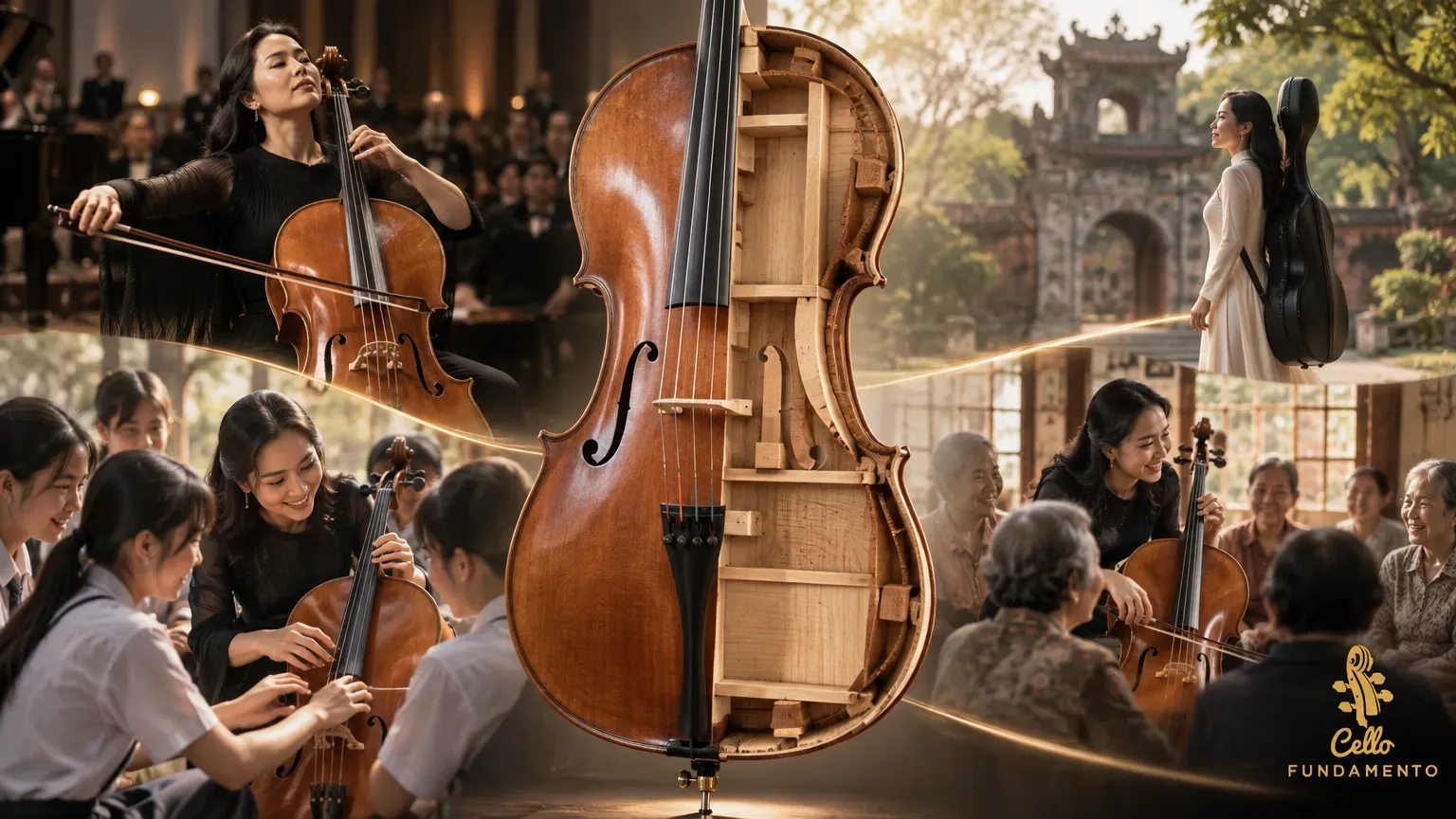
Why this Vietnamese cellist has spent ten years bringing classical music to everyone can be answered through a consistent choice: Đinh Hoài Xuân has treated access as part of artistic work, rather than as an activity separate from it. Her cello performances, international concert series, Vietnamese repertoire arrangements, and school visits all pursue the same goal—bringing the sound and presence of classical music closer to people who may not usually enter a concert hall.
That does not mean lowering musical standards or presenting the cello as a novelty. The approach is to create professional performances while changing the conditions of first contact: a student can hear the instrument live, see how it is played, and in the One Million Hands Touch Cello project, physically touch it. For audiences in Vietnam and Vietnamese communities abroad, the work also connects classical performance with familiar Vietnamese songs and cultural memory.
From a childhood connection with the cello to international expertise
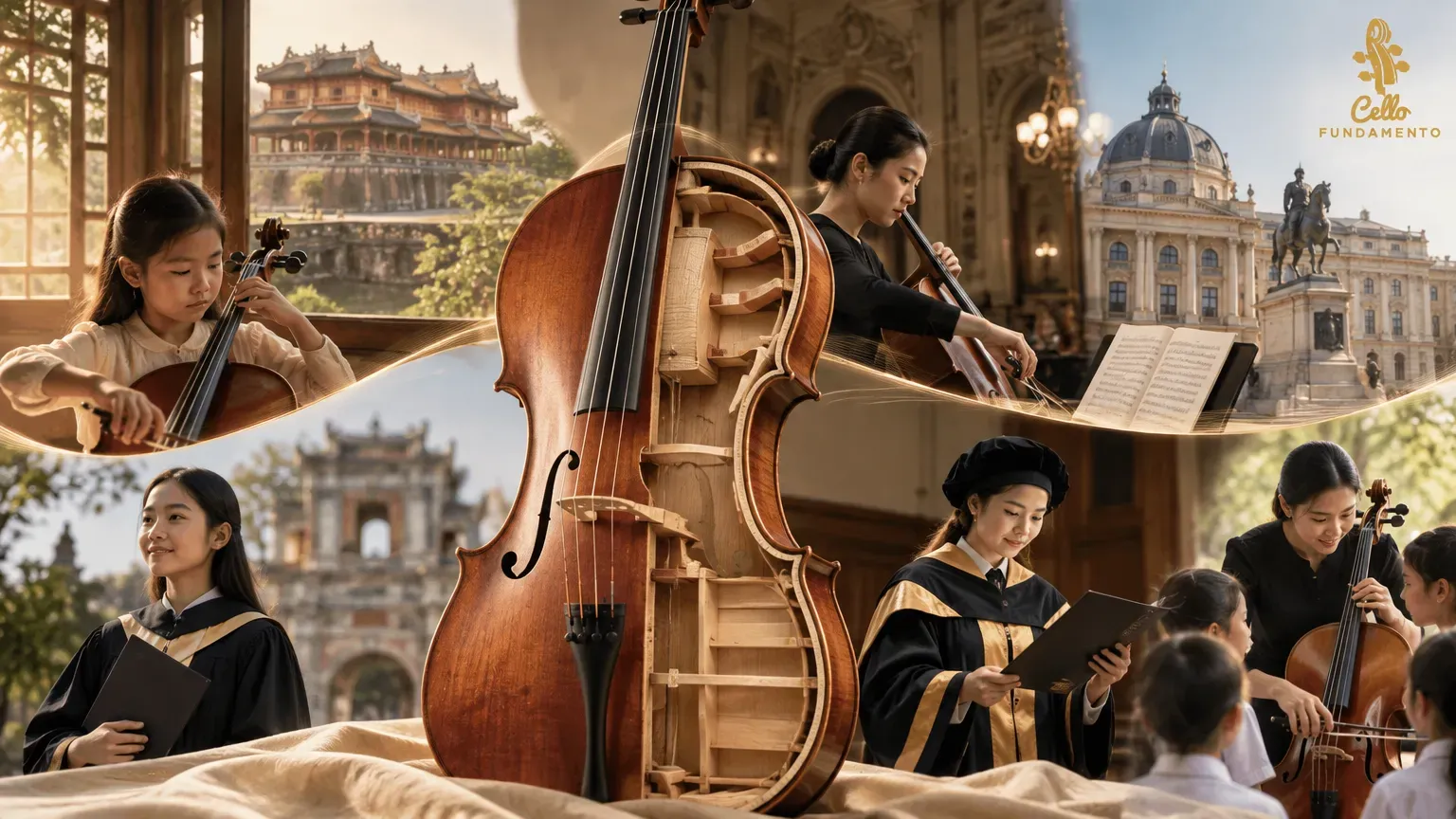
Đinh Hoài Xuân began professional music training at the age of 10. Her early connection with the cello later developed through formal study in Huế, a city that remains important to the school-outreach journey associated with her work. She graduated as valedictorian from the Huế Academy of Music, a foundation that placed technical training alongside an understanding of Vietnam’s musical education environment.
She then received a Vietnamese and Romanian government scholarship to study cello performance at the National University of Music Bucharest. Training in Bucharest gave her an international academic setting for a career rooted in a European classical tradition, while her later projects continued to bring that knowledge back into Vietnamese cultural life.
In 2019, Xuân successfully defended her doctoral dissertation and became, according to the supplied organizational account, Vietnam’s first female Doctor of Cello. This credential matters because her public-facing work is not detached from professional practice. It is built by a performer trained in solo cello repertoire, ensemble collaboration, and the discipline required by advanced study.
Her profile therefore combines two directions that are often kept apart: international specialization and local access. Rather than treating expertise as a reason to remain distant from new listeners, her projects use it as a resource for introducing the instrument with care, context, and musical seriousness.
Why Đinh Hoài Xuân chose public access over a conventional concert career
The available record does not suggest that Đinh Hoài Xuân abandoned concert performance. Instead, she has pursued a wider version of an artist’s role: performing professionally while helping create the settings in which audiences can encounter classical music for the first time.
In Vietnam, a formal concert environment can feel unfamiliar to people without prior exposure to orchestral or chamber music. The barrier is not only ticket price or geography. It can also be uncertainty about how to listen, what to expect, or whether classical music is “for” them. A cello can appear imposing before someone has heard its tone at close range or watched a player draw sound from it.
Xuân’s work addresses that distance through recurring concerts, collaborative programs, and educational visits. The stated purpose of Cello Fundamento is to bring symphonic and classical music nearer to Vietnamese audiences. The One Million Hands Touch Cello initiative makes that purpose more literal by taking the instrument into schools and inviting direct engagement.
This is a practical choice with limits. A school performance cannot replace sustained tuition, regular concert access, or a fully funded music curriculum. Yet it can create a first point of contact. For a young listener, hearing the cello live and meeting a professional musician may make a cultural form feel less abstract than it did before.
How Cello Fundamento began in 2016
Cello Fundamento began in 2016 as an annual concert series founded by Đinh Hoài Xuân. Its stated aim was to bring the cello and symphonic music closer to Vietnamese audiences through professional and creative performances. The name has since become associated with a broader set of activities, but the concert series is the starting point of the organization’s public identity.
The founding idea was cello-centered rather than cello-only. The official description presents the instrument in dialogue with piano, violin, and orchestra. This matters musically: the cello is capable of carrying a solo line, supporting harmony, and blending into a larger ensemble. It also gives a concert series multiple ways to introduce the instrument without making every program a technical showcase.
Cello Fundamento’s organizational account describes six seasons involving more than 200 international artists from countries including France, Romania, the United States, Germany, Austria, and China. This figure is a record of participation reported by the organization, not an independently audited measure of audience size or cultural impact. Still, it indicates the scale of its collaborative ambition.
Vietnamese music has also been central to the stated programming vision. The organization describes arrangements that refresh Vietnamese songs for classical ensembles and orchestral settings. Such work can place familiar melodic material beside cello performance and chamber music, giving listeners a point of recognition while preserving the distinct character of the arrangement.
In this sense, Cello Fundamento was conceived as more than a single recital. It was a continuing framework for collaboration, repertoire development, and audience connection.
A concert model built around cello, collaboration and Vietnamese repertoire
The Cello Fundamento concert model uses collaboration to widen the musical frame around the cello. Piano, violin, orchestra, singers, and other performers can change the color and scale of a program, while the cello remains a recognizable voice at its center. This makes room for solo works, chamber music, and larger ensemble writing within one artistic platform.
Its Vietnamese repertoire work is equally important. When familiar songs are newly arranged for classical forces, audiences may enter through a melody they know rather than through prior knowledge of a composer or musical period. That is not a guarantee of accessibility for every listener, but it is a thoughtful bridge between cultural familiarity and classical performance practice.
The approach also supports cultural exchange. International artists contribute different training backgrounds and performance traditions, while Vietnamese material remains visibly present in the program’s identity. The result is not simply imported repertoire presented locally; it is an attempt to make artistic collaboration speak to Vietnamese memory, language, and listening habits.
One Million Hands Touch Cello brings the instrument into schools
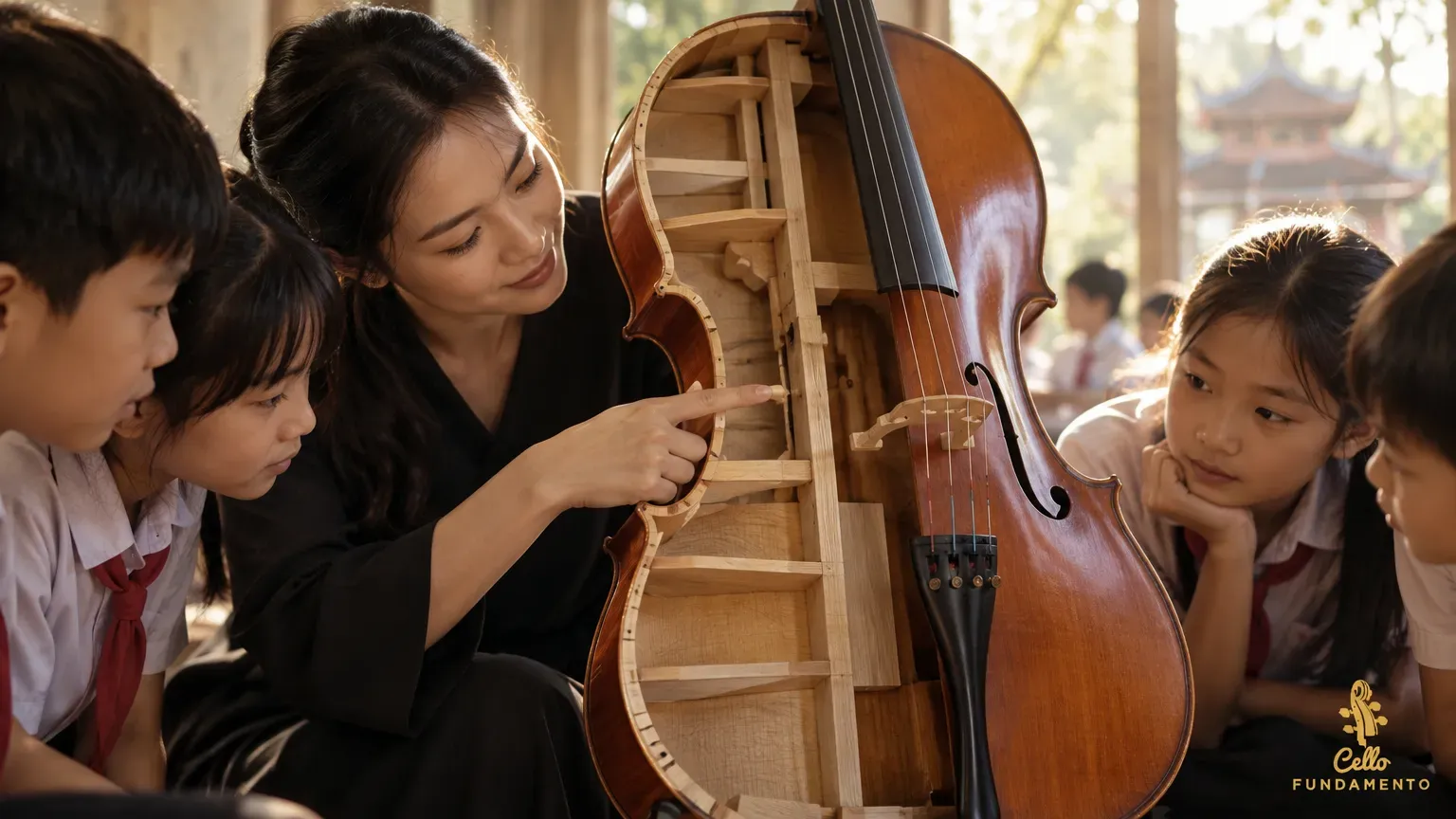
One Million Hands Touch Cello, also known as CF to School: Millionhands’ Cello, is the education and community-outreach initiative associated with Đinh Hoài Xuân and Cello Fundamento. Its central purpose is clear: bring the cello, and classical music more broadly, closer to young people and the wider Vietnamese public through performances and educational activities in schools.
The format changes the usual relationship between performer, instrument, and audience. Instead of asking students to travel to a formal venue, the project brings the cello into their own learning environment. Xuân is described as the founder of the initiative and as a direct participant in its performances and exchanges at schools across Vietnam.
Hands-on contact is essential to the project’s name and symbolism. A cello is a large, resonant wooden instrument whose sound is produced through physical detail: the curve of the bow, the vibration of strings, the player’s posture, and the contact between finger and fingerboard. Allowing students to see and touch the instrument can turn an unfamiliar object into something concrete. It gives an introductory music encounter a sensory dimension that recordings alone cannot provide.
The initiative focuses specifically on pupils and students. That emphasis reflects the supplied account’s view that early exposure to music matters, particularly for those who may not otherwise encounter classical performance. Its activities are presented as free community performances and classical-music education in schools, rather than as a substitute for formal conservatory training.
The project’s stated aspiration is one million hands. That number functions as both a future goal and a public expression of scale: each touch represents an effort to make an instrument often associated with elite concert culture physically and emotionally less distant. The documented account reports 300,000 touches or young people reached so far.
For supporters, the practical significance lies in the model itself. Outreach is not limited to a message about the value of music; it involves travel, performance, coordination with schools, and direct interaction. The project makes public access part of the work required to sustain a classical music culture.
From Huế through Central Vietnam, the Central Highlands and Hà Nội
The journey began in Huế, the city linked to Đinh Hoài Xuân’s childhood and early musical development. From there, the project expanded to schools across Central Vietnam, the Central Highlands, and Hà Nội. This geographic movement is significant because it places classical-music outreach beyond one established urban concert audience.
The supplied project account names several participating institutions: the University of Civil Engineering in Central Vietnam, the Faculty of Engineering and Technology at the University of Huế, Hanoi University of Civil Engineering, Thủy Lợi University in Hà Nội, and Newton Primary School in Hà Nội. The range includes university students and younger children.
These examples show a deliberately mixed educational setting rather than a program confined to specialist music schools. However, the available material does not provide a complete school-by-school schedule, attendance breakdown, or frequency of visits. It supports the conclusion that the initiative has traveled across multiple regions, not a precise map of every activity.
What the reported 300,000 touches represent
Cello Fundamento’s project account reports that the cello has carried the “energy” of 300,000 hands and reached 300,000 young people nationwide. Read carefully, this is a project-reported milestone describing direct contact and outreach reach. It should not be treated as independently audited data, a measure of repeat participation, or proof that every participant received the same depth of engagement.
The wording nevertheless captures the initiative’s distinctive method. “Touches” are not merely ticket counts. They refer to the act of bringing an instrument within reach—an encounter that can include seeing it, hearing it performed, and physically touching it in a school setting.
There are also unavoidable questions behind the figure. One young person may have encountered the cello briefly, while another may have attended a fuller performance or discussion. The available sources do not separate these experiences. The strongest responsible interpretation is that 300,000 represents substantial reported exposure, not a measured long-term outcome.
How the projects make classical music feel closer to first-time listeners
Accessibility in these projects is created through format, not through a claim that every listener will respond in the same way. A live cello demonstration can make sound visible: students can watch the bow move, notice the instrument’s scale, and connect a musician’s gestures to what they hear. That directness can reduce the mystery surrounding a form often introduced through formal language and distant venues.
Collaboration provides another entry point. Concerts that combine cello with piano, violin, orchestra, singers, or newly arranged Vietnamese songs offer varied textures and references. A listener may arrive through a familiar Vietnamese melody, then encounter the color of a classical ensemble. The artistic objective is connection, not simplification.
School outreach also changes who initiates the encounter. First-time listeners do not need to decide in advance that classical music belongs to them; the program meets them in a shared educational space. This is particularly relevant for young people without access to private instrumental lessons or regular concert attendance.
Still, proximity is not the same as lasting participation. A single encounter may inspire curiosity, indifference, or something in between. Sustained access would require continued programming, teachers, instruments, scholarships, and pathways for interested students. Cello Fundamento’s scholarship mission points toward that wider need, while the available evidence does not yet show how many outreach participants continue into music study.
From an annual concert series to a social enterprise
On September 14, 2023, the concert-series foundation of Cello Fundamento formally became Cello Fundamento Social Enterprise Co., Ltd. in Hà Nội. The company profile identifies Đinh Thị Hoài Xuân as its legal representative and describes the organization as a social enterprise working in classical music, especially for children and young people.
This formalization gives the mission a broader institutional structure. The organization’s stated activities include the Cello Fundamento concert series, the One Million Hands Touch Cello school program, a Cello Fundamento Talent Scholarship, and other music and cultural initiatives. Moving from an annual series to a social enterprise does not itself demonstrate financial sustainability or long-term impact, but it clarifies the intention to organize social and educational work alongside performance.
The scholarship component addresses a different access barrier from school outreach. A first encounter may introduce a young person to classical music; financial support can potentially help those who wish to study further. The supplied profile says the fund supports young people who love classical music, including learners facing difficulties, but it does not provide award numbers, selection criteria, or recipient outcomes.
As a social enterprise, Cello Fundamento also frames concerts as part of a public-benefit ecosystem. International collaboration can serve artistic exchange; Vietnamese arrangements can support cultural preservation; and education programs can take music into schools. The strength of this model lies in its connected purpose. Its challenge is maintaining resources, artistic quality, and transparency across several kinds of activity.
A documented timeline of the ten-year journey
Several milestones outline the development of Đinh Hoài Xuân’s public-access mission:
At age 10, she began professional music training. She later graduated as valedictorian from the Huế Academy of Music and continued cello study at the National University of Music Bucharest on a Vietnamese and Romanian government scholarship.
In 2016, she founded Cello Fundamento and began maintaining it as an annual concert series in Vietnam. The series placed the cello in collaboration with other instruments, ensembles, and international performers.
In 2019, Xuân successfully defended her doctoral dissertation. The supplied account identifies her as Vietnam’s first female Doctor of Cello.
Across its operating journey, the One Million Hands Touch Cello initiative brought performances and educational encounters to schools, beginning in Huế and extending through Central Vietnam, the Central Highlands, and Hà Nội. Its organizational account reports 300,000 young people reached.
On September 14, 2023, Cello Fundamento became a registered social enterprise in Hà Nội. The timeline shows evolution from specialist training, to concert creation, to organized community and education activity.
What the available evidence shows—and what it does not yet prove
The available organizational material documents several important facts: Cello Fundamento was founded in 2016; it has operated an annual concert series; the organization reports six seasons and more than 200 international artists; One Million Hands Touch Cello has visited named schools and regions; and Cello Fundamento became a social enterprise in 2023.
It also provides a reported reach figure of 300,000 touches or young people for the school initiative. This is meaningful evidence of stated activity and ambition, especially because the project identifies its method and intended audience. It supports describing the work as substantial outreach.
However, it does not yet prove long-term effects such as increased concert attendance, continued instrument study, improved music-literacy outcomes, or changes in cultural participation. No independent evaluation, longitudinal participant study, detailed budget information, or representative audience interviews are supplied. A balanced profile should recognize both realities: documented work is taking place, while broader impact requires further evidence.
The artist’s perspective and the recognition surrounding her work
The artist’s public work has attracted recognition from figures in Vietnamese music. Composer Phó Đức Phương described Đinh Hoài Xuân as:
“A female artist who has gone all the way, accepted every challenge, nurtured a strong ambition in her own way, and is determined to bring the wonderful beauty of the cello’s sound to conquer the public.”
This is an attributed artistic assessment, not an independent evaluation of the programs’ outcomes. Its value is in showing how a respected composer interpreted the commitment behind Xuân’s cello-centered path.
The professional context reinforces that interpretation. Xuân’s qualifications include advanced study in Bucharest, doctoral completion in 2019, and ongoing work as founder of the Cello Fundamento concert series and the One Million Hands Touch Cello initiative. Her role is not limited to appearing as a soloist; the supplied material identifies her as a founder, organizer, performer, and direct participant in educational exchanges.
Recognition should be understood alongside evidence rather than instead of it. The most grounded picture is of an artist using her training and public profile to build opportunities for musical encounters, while the long-term results of those encounters remain an area for future documentation.
Why Đinh Hoài Xuân’s work matters for classical music in Vietnam
Đinh Hoài Xuân’s work matters because it treats classical music in Vietnam as a living public practice, not only a concert-hall tradition. Cello Fundamento links high-level performance with Vietnamese repertoire, international collaboration, school outreach, and an emerging scholarship mission.
For first-time listeners, especially young people, the cello can become less remote when it appears in a school, a familiar song arrangement, or a performance shaped around dialogue between instruments. For established listeners, the projects offer a model in which artistic standards and wider access are not opposing goals.
The evidence supports a ten-year journey of institution-building and outreach. It does not yet prove every hoped-for social outcome. But the sustained effort to create contact—between artist and student, Vietnamese song and classical arrangement, local audiences and international performers—helps expand the space in which classical music can be heard, understood, and valued.