What Does Vietnam Sound Like on a Cello?
Table of Contents
- 1. What Vietnam can sound like when its melodies meet the cello
- 2. The cello’s tone: warmth, voice and emotional depth
- 3. How cello technique can suggest Vietnamese instruments
- 4. Listening through Cello Fundamento’s Vietnamese repertoire
- 5. Where adaptation ends and cultural authenticity begins
- 6. A practical listening guide for Vietnamese-inspired cello music
- 7. Why the cello matters in Cello Fundamento’s cultural mission
What Vietnam can sound like when its melodies meet the cello
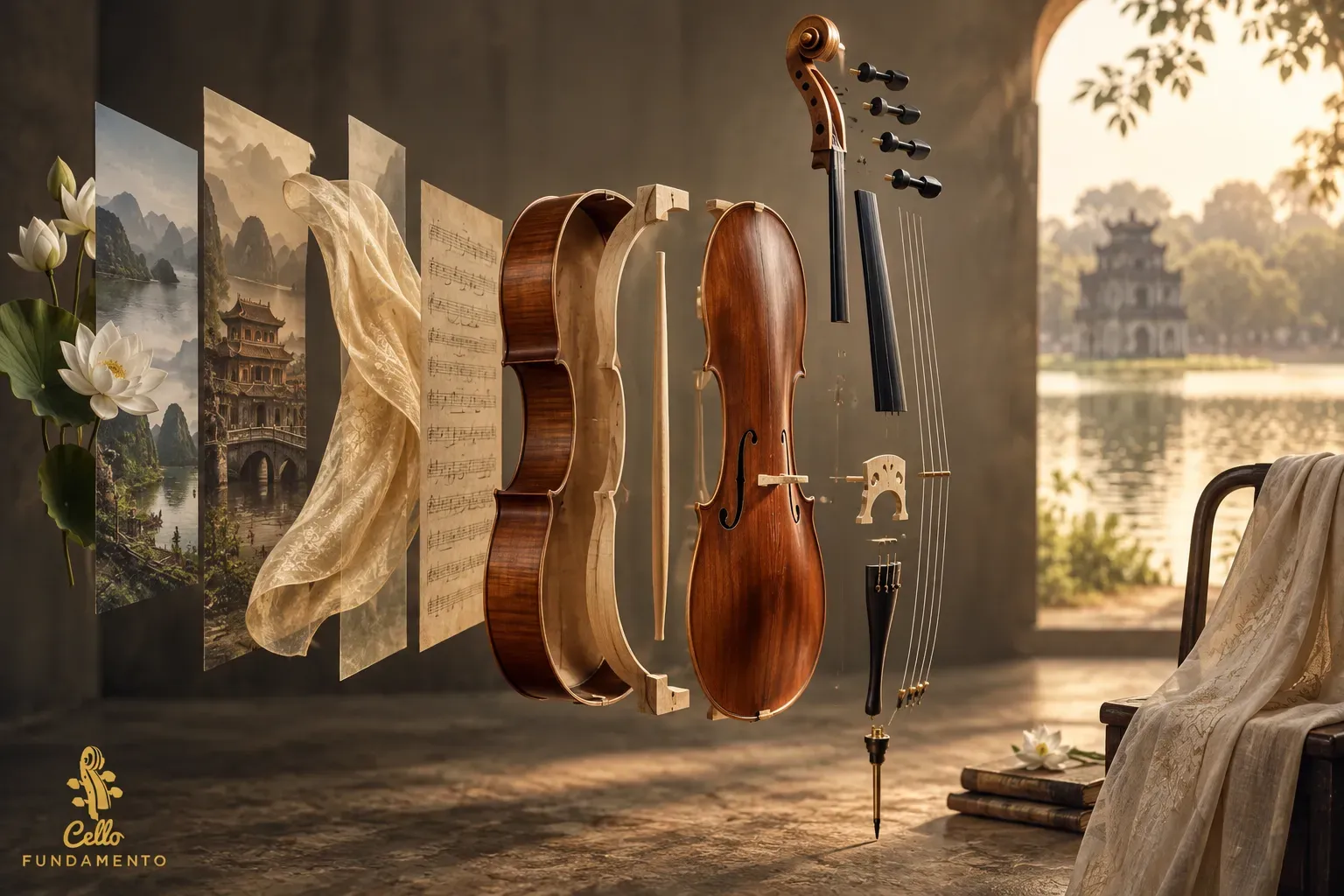
What does Vietnam sound like on a cello? Not a literal copy of any one Vietnamese instrument or regional tradition. Instead, it can sound like a melody that breathes: a line that rises patiently, leans into a note, glides toward another, and leaves room for memory.
The cello brings a low, human-like register to Vietnamese-inspired music. Its sustained sound can carry the unhurried pull of a folk melody, while its upper register can brighten into a more fragile, singing voice. In an arrangement, the instrument may hold a long phrase against piano or orchestra, suggest the contour of a vocal line, or create a darker foundation beneath familiar Vietnamese songs.
That translation matters especially when a listener knows Vietnam through distance. A melody associated with Hanoi, Huế, a family gathering, or an old recording can take on another colour when heard through bowed strings. The result is not “traditional Vietnamese music played exactly on cello.” It is Vietnamese cello music: an interpretation shaped by a Western instrument, an arranger’s choices, and the performer’s phrasing.
Cellist Đinh Hoài Xuân and Cello Fundamento offer a useful context for hearing this meeting of sounds. Their programmes place cello alongside piano, orchestra, voices, and Vietnamese repertoire, inviting listeners to hear classical performance as a space where cultural memory can be revisited rather than preserved behind glass.
The cello’s tone: warmth, voice and emotional depth
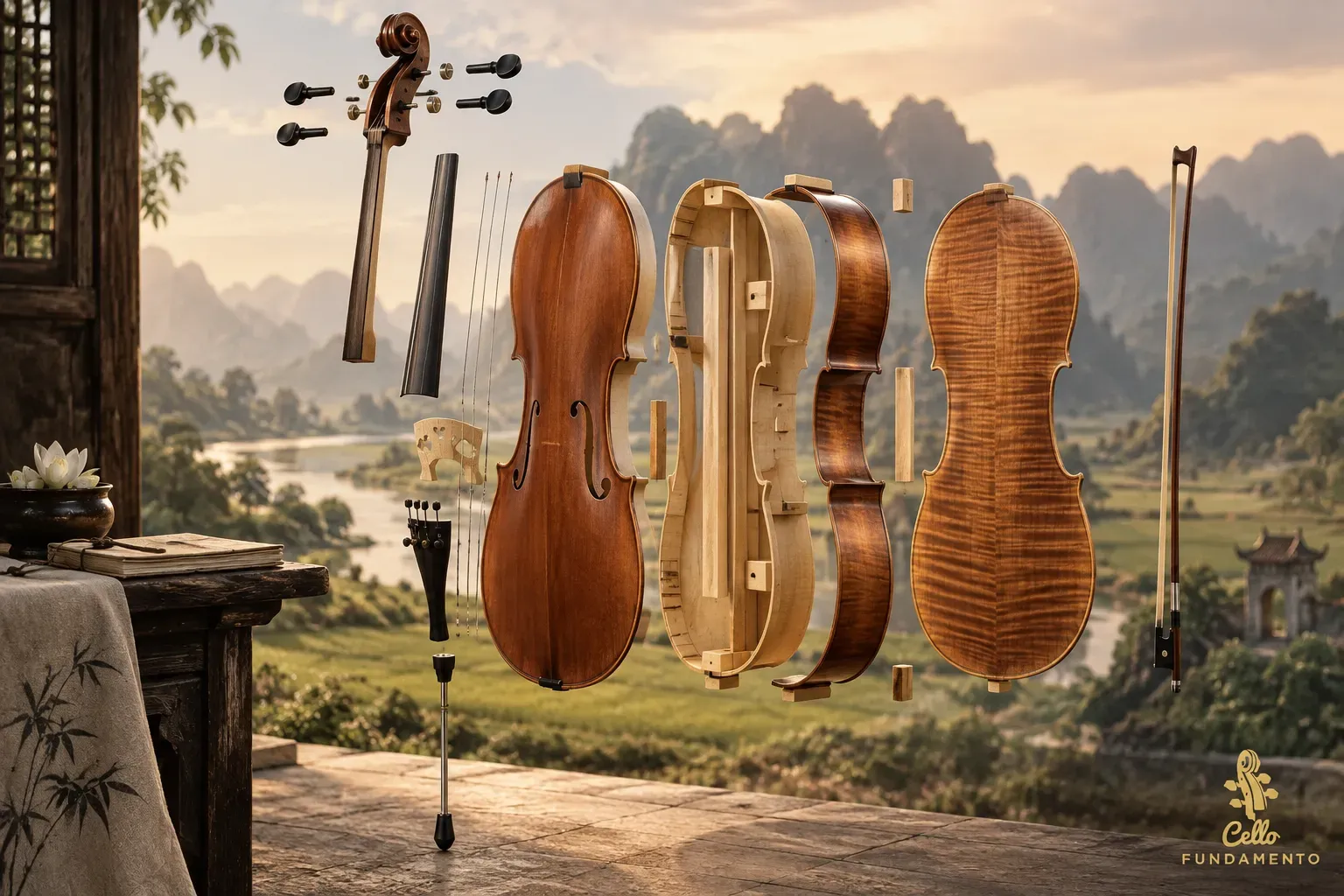
The cello is often described as close to the human voice, not because it speaks words, but because it can shape a single note with breath-like continuity. A player can begin softly, allow the sound to open, narrow it to a thread, or let it fade without an abrupt ending. That flexibility makes the cello particularly persuasive in melodies built around longing, reflection, tenderness, or return.
Its range also supports several emotional perspectives at once. In its lower register, the instrument can feel grounded and intimate, like a voice speaking close by. In the middle register, it is capable of direct lyricism. Higher notes may sound exposed, bright, or aching. When Vietnamese melodies are arranged for cello, these shifts of register can suggest changing distance: an inward recollection, an expansive landscape, or a melody reaching toward someone absent.
Tone is created through more than the instrument itself. Bow speed, bow pressure, contact point, and vibrato all change colour. A broad bow stroke near the fingerboard can make a phrase softer and more veiled; a clearer stroke nearer the bridge can give it definition. None of these choices belongs exclusively to Vietnamese music, but they give performers a broad palette for responding to its melodic and emotional character.
For listeners, the key is to hear the cello as a storyteller rather than a substitute for a singer or traditional instrument. Its warmth can carry the weight of a familiar tune, but its grain, resonance, and physical bowing remain unmistakably its own.
Pentatonic contours and the shape of Vietnamese melody
Many listeners associate Vietnamese folk melody with pentatonic contours: melodic movement that draws from five-note collections rather than the seven-note major and minor scales familiar in much Western classical music. This is a helpful starting point, but not a complete definition. Vietnam contains diverse regional, historical, theatrical, folk, and contemporary musical practices, and no single scale pattern represents them all.
On cello, a pentatonic contour can sound spacious because the melody may travel without the strong pull of Western harmonic resolution. Instead of moving predictably toward a final chord tone, a phrase may hover, repeat a small turn, or descend gradually as though it were speaking. The ear notices the direction of the line as much as the destination.
A cellist arranging a Vietnamese folk melody may use open strings, carefully chosen finger patterns, or a resonant key to let the line ring. Yet the important element is not merely selecting five notes. Phrasing gives those notes meaning. A small pause before a return, a gentle swell at the top of a phrase, or a restrained ending can change how the contour is heard.
When listening, follow the melody’s silhouette. Does it climb in steps, circle a central pitch, or fall in a long arc? That shape may communicate more about the music’s expressive world than a technical label such as “pentatonic” ever can.
Bending, vibrato and microtonal expression
Western string instruments are not locked into fixed frets, so a cellist can place a finger slightly above or below a standard tempered pitch. That freedom makes pitch shading possible. In Vietnamese-inspired cello music, a performer may approach a note with a small slide, delay full arrival, or allow vibrato to widen and narrow as the phrase changes.
These gestures can suggest microtonal inflections: subtle pitch relationships that do not fit neatly into the equal-tempered semitones of a piano keyboard. However, it would be inaccurate to assume that every Vietnamese melody requires the same inflections, or that a cello automatically reproduces the tuning systems of Vietnamese traditional genres. Specific practices depend on repertoire, region, instrument, and performer.
Vibrato also needs restraint. A continuous, wide classical vibrato may smooth away the distinct profile of a melodic turn. A narrower vibrato, delayed vibrato, or a nearly straight tone can preserve clarity before the player adds emotional weight. Likewise, glissando should connect meaningful notes rather than become a decorative effect applied everywhere.
For the listener, these details are heard as tension and release. Notice whether a pitch seems to settle immediately or arrive by degrees. The expressive value lies in the journey between notes, not in treating “bending” as an exotic sound effect.
How cello technique can suggest Vietnamese instruments
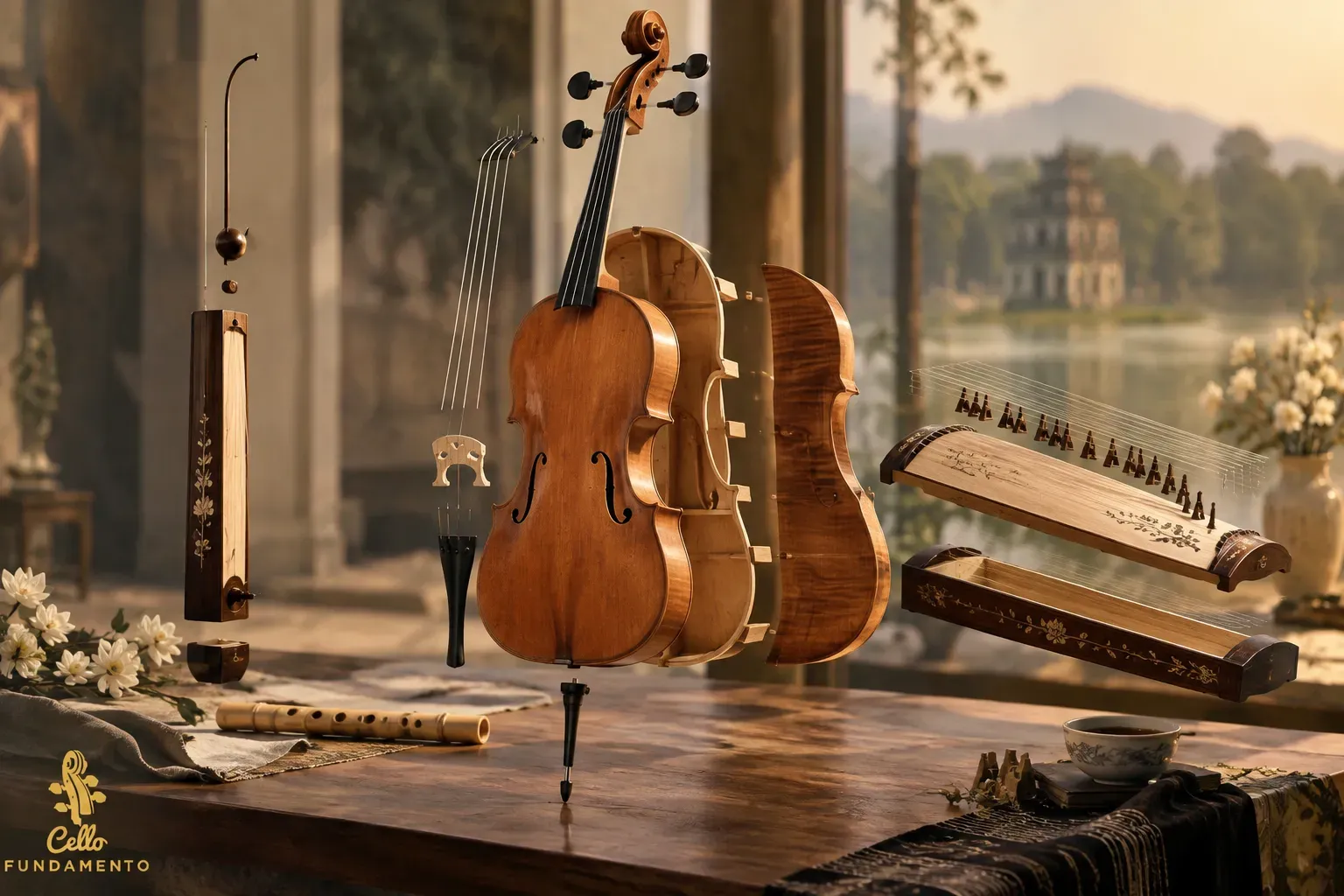
A cello can suggest aspects of Vietnamese instruments, but suggestion is different from imitation. The đàn bầu, đàn tranh, bamboo flute, and other instruments have their own construction, tuning, playing methods, repertories, and histories. A bowed cello cannot duplicate those identities simply by adding slides or ornamentation.
What it can do is borrow broad expressive ideas. A continuous bow can create a sustained line that resembles vocal or instrumental singing. A carefully measured slide can connect pitches in a way that feels less block-like than ordinary Western articulation. Light bow pressure can produce an airy edge, while a focused attack can make a plucked or struck figure feel more defined.
Left-hand technique matters as much as the bow. A player may shift audibly between positions, release a note before moving onward, or use a portamento that carries emotional momentum. Double stops and open-string resonance can thicken a melody, although dense harmony may not serve every arrangement. Sometimes one exposed line is the more respectful and expressive choice.
Arrangement is equally important. The cello may carry a melody while piano supplies harmonic space; it may answer a clarinet, sit inside an orchestral texture, or share material with voice. In each setting, the goal should be musical dialogue rather than a claim that the cello has become another instrument.
The most convincing Vietnamese-inspired performance therefore begins with listening: to the melody’s pacing, its ornaments, its text when one exists, and the cultural context in which the song has been known.
Dan Bau-like effects: sustained tone, slides and vocal phrasing
The đàn bầu is a distinctive Vietnamese monochord whose sound and pitch control arise from its own physical design and performance technique. A cello cannot reproduce that mechanism exactly, including the đàn bầu’s harmonic-based sonority. Still, its long bow strokes and fretless fingerboard allow a cellist to evoke a related sense of sustained, bending lyricism.
A Dan Bau-like effect on cello may begin with continuity. Rather than separating every note, the player can carry one bow direction across a phrase and make a shift feel like part of the line. A measured glissando can then connect two pitches as though the melody were being drawn rather than stepped through.
Vocal phrasing is the second ingredient. A phrase might lean forward into its highest note, soften after arrival, then taper with minimal vibrato. The effect is not about copying a timbre; it is about allowing the melody to sound flexible, responsive, and alive. Silence between phrases matters too. A small pause can make the next entrance feel like an answer.
There are limits. Cello strings, bow friction, and resonance respond differently from a đàn bầu. Attempts to force a thin or overly nasal colour may weaken the cello’s natural voice. A stronger approach respects the cello’s depth while using slides and sustained bowing as interpretive tools.
Dan Tranh-inspired clarity, articulation and resonance
The đàn tranh is a plucked zither, so its sound begins with attack, bloom, and decay rather than the continuously sustained tone of a bowed cello. A cello cannot recreate that plucked mechanism, but an arranger or player can draw inspiration from its clarity, brightness, and resonance.
Pizzicato is the most obvious parallel. Clean left-hand preparation and a deliberate right-hand release can make individual notes speak with definition. Short bowed strokes may also create articulated figures when a melody needs rhythmic lift. In either case, the player should avoid making every note heavy; space around the attack allows resonance to be heard.
Open strings can add a ringing quality, while light double stops may suggest layered resonance. These techniques work best when they support the melodic line rather than decorate it indiscriminately. A busy texture can obscure the graceful outline that makes a tune memorable.
Listeners can notice contrast. Does the cello move from long, singing phrases into crisp, bell-like gestures? That change of articulation may be an arrangement choice inspired by plucked-string clarity, not an assertion that the instrument now sounds exactly like a đàn tranh.
Listening through Cello Fundamento’s Vietnamese repertoire
Specific repertoire gives these ideas a practical frame. The programme for the Vietnam–Romania Friendship Concert, presented as Cello Fundamento 12 at the Romanian Athenaeum in Bucharest, includes Vietnamese works in several ensemble formats. The listed programme pairs Vietnamese songs with orchestra, voice, piano, guitar, bamboo flute, T’rung, clarinet, choir, and cello.
For a listener interested in Vietnamese cello music, this range is valuable. It shows that cultural expression does not rest on one instrument carrying every reference. The cello may be soloist in one work, part of a chamber-like conversation in another, or absent while Vietnamese song is presented through voice and orchestra. That variety discourages a simplistic idea that a single Western instrument can stand in for an entire musical heritage.
The concert programme identifies Đinh Hoài Xuân as cello soloist in Trở về đất mẹ by Nguyễn Văn Thương, arranged by Mariano Castro for cello, piano, and the Bucharest Symphony Orchestra under conductor Bogdan Postolache. It also lists Xuân in Hướng về Hà Nội by Hoàng Dương, arranged by Lưu Hà An for cello, clarinet, piano, choir, and orchestra, again conducted by Postolache.
Those credits are important. They identify the composers, arranger, performers, and ensemble forces without claiming unverified details about a particular recording or bowing choice. Use the programme as a listening map: hear how a familiar Vietnamese song is placed within a large classical ensemble, then ask what the cello contributes to its emotional centre.
Returning to the Motherland: Trở về đất mẹ
Trở về đất mẹ, translated in the programme as Returning to the Motherland, is credited to composer Nguyễn Văn Thương. For the Vietnam–Romania Friendship Concert, it is listed as an arrangement by Mariano Castro for Đinh Hoài Xuân on cello, Iulian Ochescu on piano, and the Bucharest Symphony Orchestra, conducted by Bogdan Postolache.
Even before hearing an interpretation, the title establishes an emotional direction: return. For overseas Vietnamese listeners, “motherland” may bring together geography, language, family stories, and memories formed at different distances from Vietnam. But a title does not prescribe one feeling. Some may hear reassurance; others may hear grief, curiosity, or a relationship with home that remains unresolved.
The instrumentation offers a useful listening question. How does a solo cello function when piano and orchestra are present? The cello can emerge as a single narrative voice, but it can also be shaped by the harmonic ground of the piano and the larger colour of the orchestra. Listen for changes in scale: an intimate line may be answered by a wider orchestral sound, making private feeling feel communal.
Do not assume that every slide or sustained note is a direct quotation from a Vietnamese traditional instrument. Instead, hear whether the phrasing makes the melody feel spoken, sung, or ceremonially broadened. That is where arrangement becomes interpretation: not a museum reconstruction, but a new setting that keeps the song’s cultural reference visible.
Turning Towards Hanoi: Hướng về Hà Nội
Hướng về Hà Nội, translated as Turning Towards Hanoi, is credited in the programme to Hoàng Dương. Its listed arrangement is by Lưu Hà An for cello, clarinet, piano, choir, and the Bucharest Symphony Orchestra. Đinh Hoài Xuân is named as the cellist, with Trần Khánh Quang on clarinet and Bogdan Postolache conducting.
Hanoi is not simply a scenic image in this context. For many listeners, it can be a city remembered through family, streets, weather, language, departure, or imagined return. A cross-cultural concert setting adds another layer: the work was programmed in Bucharest, bringing a Hanoi-focused song into a Romanian symphonic venue.
The ensemble itself invites attentive listening. Clarinet and cello can create contrast between breath and bow, while piano can clarify rhythm or harmony. A choir extends the human dimension of the song, and orchestra enlarges its atmosphere. Rather than searching for one instrument to “sound Vietnamese,” notice how the different timbres build a shared musical environment.
A cello line may feel especially intimate beside choir and orchestra because its sound is physically drawn by the bow. It can hold a melody against a large ensemble without needing to overpower it. Whether the arrangement presents the cello as leader, partner, or bridge depends on the score and performance; listeners should let the actual musical relationship guide their response.
Where adaptation ends and cultural authenticity begins
Cultural authenticity is not achieved by adding a pentatonic pattern, a slide, or a Vietnamese title to a Western classical arrangement. These elements may be meaningful, but they do not replace knowledge of a song’s origin, language, performance history, or place within a living tradition.
A responsible adaptation makes its choices visible. It credits the composer and arranger. It distinguishes between a direct arrangement of an existing work and a new composition inspired by Vietnamese musical ideas. It avoids presenting one regional sound as the sound of all Vietnam. It also recognizes that Vietnamese music continues to change through popular song, conservatory training, diaspora communities, theatre, folk practice, and contemporary experimentation.
The cello’s role is therefore interpretive. It can carry a Vietnamese melody with sensitivity, open it to orchestral colour, and help new audiences encounter it. It should not be asked to erase the need for traditional instruments or the musicians who sustain their repertories.
For performers, humility is practical as well as ethical. Study the source melody, consult knowledgeable artists when possible, and avoid exaggerated ornamentation based on stereotypes. For audiences, curiosity is equally important: listen to cello arrangements alongside Vietnamese vocal and instrumental traditions rather than treating one version as definitive.
Cross-cultural musical fusion is strongest when it expands attention. The arrangement can become a doorway—toward the original song, toward its creators, and toward the many distinct musical worlds that exist within Vietnam.
A practical listening guide for Vietnamese-inspired cello music
You do not need formal training to listen closely. Begin with one uninterrupted hearing, allowing the overall mood to arrive before trying to identify techniques. On a second hearing, use the following checklist to focus your attention.
- Follow the melody: Does it rise in steps, hover around a central note, or descend in long arcs? Notice the contour before naming the scale.
- Hear the pitch movement: Listen for a note that is approached by a slide, softened by vibrato, or allowed to settle gradually. These gestures may create expressive pitch shading.
- Notice bow colour: Is the cello velvety and sustained, clear and direct, or lightly textured? Bow speed and contact point can change the emotional temperature of the same melody.
- Track register: Lower notes can feel grounded; higher notes may feel vulnerable or luminous. Ask why a phrase moves where it does.
- Listen to the ensemble: In an orchestral arrangement, hear whether piano, clarinet, choir, or strings echo the cello, support it, or lead the musical conversation.
- Learn the context: Read the composer and arranger credits, seek the song’s Vietnamese text when relevant, and compare an arrangement with other performances of the work.
For verified programme information and official media, begin with Cello Fundamento’s website. Then let repeated listening do its work. The goal is not to prove that you can identify every technique; it is to hear more clearly how sound, memory, and arrangement meet.
Why the cello matters in Cello Fundamento’s cultural mission
Cello Fundamento was founded by cellist Đinh Hoài Xuân in 2016 as an annual concert series intended to bring symphonic and classical music closer to Vietnamese audiences. In 2023, the initiative became a social enterprise in Hanoi, with a stated mission of widening access to classical music, particularly for younger generations.
The cello sits at the centre of that mission because it can move between roles. It can stand alone as a solo voice, blend with piano and violin, or speak within a symphony orchestra. That flexibility makes it a practical instrument for programmes that place classical repertoire beside newly arranged Vietnamese songs.
Cello Fundamento’s educational work extends the idea beyond the concert hall. Its One Million Hands Touch Cello project brings performances and music-education activities into schools. Supplied project information describes the initiative as reaching schools from Huế through central and highland regions to Hanoi, with the aim of bringing classical music closer to students and communities.
For listeners abroad, this context gives Vietnamese cello music a deeper meaning. The instrument is not only a vehicle for nostalgia. It is also part of an ongoing effort to make classical listening more accessible in Vietnam while carrying Vietnamese repertoire into international settings.
So when Vietnam meets the cello, the most meaningful sound may be connection: between a familiar song and a new arrangement, between young listeners and a concert stage, or between a distant memory of home and the present moment of listening.