What Does Home Sound Like When You Live 8,000 Miles Away?
Table of Contents
- 1. When Home Is 8,000 Miles Away, It May Begin With a Sound
- 2. How Distance Turns Everyday Noise Into an Acoustic Memory
- 3. The Vietnamese Soundscape Many People Carry Abroad
- 4. How to Recreate the Sound of Home in a New Country
- 5. Why Music Can Become a Bridge Between Expatriate Lives
- 6. Dinh Hoai Xuan and Cello Fundamento: Carrying Vietnamese Belonging Through Sound
- 7. A Gentle Listening Practice for the Days You Miss Home
- 8. Home Is Not Only Where You Return—It Is What You Continue to Hear
When Home Is 8,000 Miles Away, It May Begin With a Sound
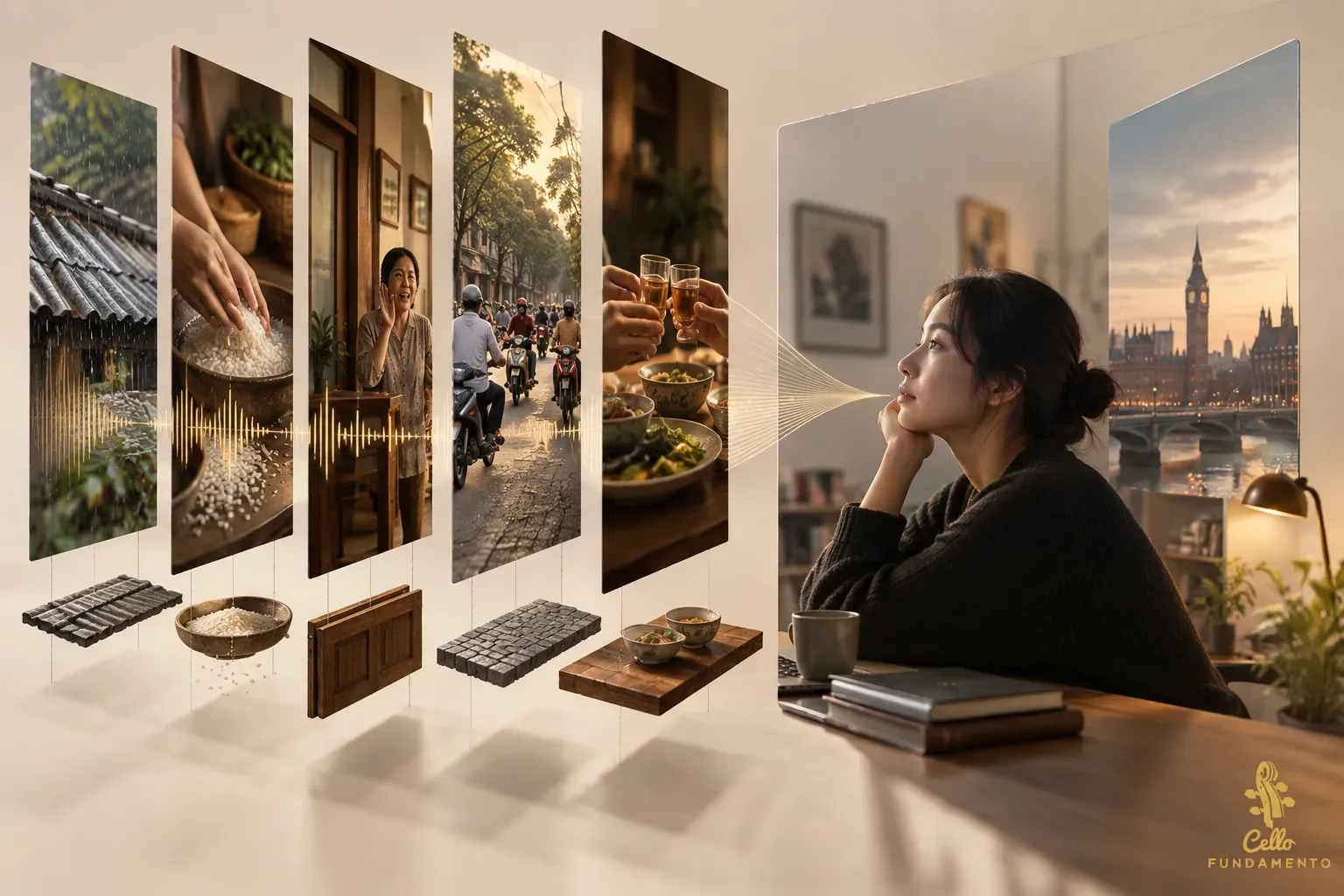
What does home sound like when you live 8,000 miles away? For many Vietnamese people living overseas, the answer is rarely a single song or landmark. It may arrive unexpectedly: rice washing in a bowl, a parent calling from another room, rain striking a corrugated roof, the impatient pulse of motorbikes, or the bright clink of glasses at a family meal.
Distance changes the scale of ordinary things. Sounds once treated as background can become precious because they belong to a time, a language, and a rhythm of life that cannot be packed into a suitcase. They may bring comfort, but they can also sharpen homesickness. Both responses are understandable.
Home is not identical for every Vietnamese American, international student, worker, or family separated across borders. Some remember Hanoi’s dense street music; others remember Huế rain, a southern market, a coastal hometown, or a kitchen in California where Vietnamese was spoken every morning. Yet sound can hold a thread between these places: a quiet reminder that belonging can travel, even when people cannot.
How Distance Turns Everyday Noise Into an Acoustic Memory

An acoustic memory is a sound linked, through repetition and feeling, to a person, place, or moment. It is not a formal diagnosis, and it does not affect everyone in the same way. Still, many people recognize the experience: a familiar melody, voice, or household noise can suddenly make a faraway room feel close.
Before migration or long-distance living, everyday sound is often practical. A kettle signals tea. A gate opening means someone has arrived. A television in the next room is simply part of the evening. After years abroad, those sounds can gain emotional weight because they are no longer ordinary. They become evidence of a world that continued without you, while also remaining inside you.
This is one reason homesickness can be triggered by something small. A Vietnamese song heard in a supermarket, the cadence of a relative’s voice note, or the sound of rain on a particular kind of window may connect present life with earlier routines. The feeling is not always nostalgia for a perfect past. It can include longing, gratitude, grief, pride, and even uncertainty about where home truly is.
Technology can make these connections more available. Global broadcasts, family recordings, video calls, and online performances give listeners new ways to encounter familiar sound. But a recording is not a substitute for a grandmother’s presence, a neighborhood walk, or a shared meal. Its value lies elsewhere: it can create a small, intentional space for memory when physical distance cannot be changed.
Why Familiar Household Sounds Can Feel Like Belonging
Household sounds are intimate because they usually happen without ceremony. They accompany waking, cooking, resting, studying, arguing, laughing, and waiting. A ceiling fan, the scrape of chopsticks against a bowl, a pressure cooker releasing steam, or a door latch may seem insignificant until they disappear from daily life.
For someone abroad, these sounds can suggest more than a building. They may recall the comfort of being known without needing to explain oneself: knowing when meals happen, what language is spoken across the room, and how family members move through the day. The sound itself is not magical. Its meaning comes from the relationships and routines attached to it.
That is why another person’s “noise” can become someone else’s refuge. A recreated soundscape may not restore the past, but it can acknowledge that ordinary life was meaningful. Listening with care can turn a fleeting ache into a gentler form of recognition.
The Difference Between Missing a Place and Missing Its Atmosphere
Missing a place can mean wanting to return to a street, a city, or a family home. Missing its atmosphere is broader and sometimes harder to name. It is the feeling created by many details happening together: humid air, familiar accents, scooters passing, vendors calling, music from a neighboring house, and the tempo of people moving around you.
Atmosphere cannot be fully reproduced by one photograph or one dish. Sound comes closer because it unfolds in time. It can bring back the pace of a morning or the spaciousness of a late evening. Yet listeners should not pressure themselves to feel only warmth. A soundscape may also reveal what has changed, what was difficult, or what no longer fits.
Living between cultures often means carrying several atmospheres at once. The goal is not to choose one as more authentic. It is to make room for the sounds that help you understand your own changing idea of home.
The Vietnamese Soundscape Many People Carry Abroad
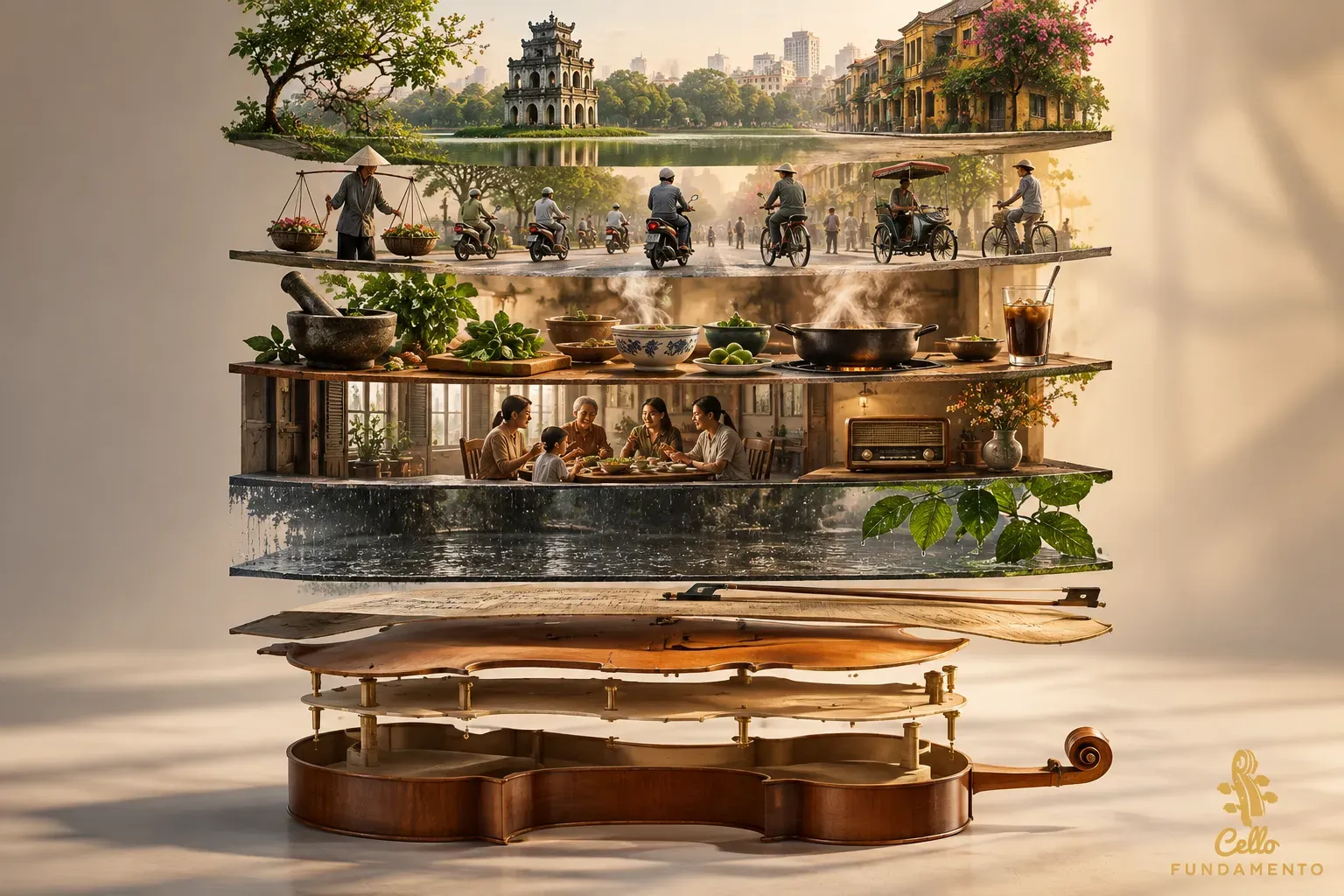
There is no single Vietnamese soundscape. Vietnam contains many regions, languages, family histories, and musical traditions. Still, people who have lived there may recognize certain layers of sound: the early call of a street vendor, motorbikes gathering and dispersing, a metal spoon against a glass of iced coffee, birds in a narrow courtyard, or conversation rising from a market.
For some, home begins in the kitchen. There may be water running over herbs, oil warming in a pan, a mortar being used, bowls being set down, and relatives speaking Vietnamese in overlapping sentences. For others, it is a quieter sound: rain outside, a radio playing softly, the evening news, or a loved one singing under their breath.
Vietnamese music carries another layer of memory. A song can preserve the shape of a place without describing it literally. It may hold the softness of an old ballad, the open feeling of a folk melody, the drama of a modern song, or the deep resonance of a cello interpreting Vietnamese material. For listeners abroad, a familiar musical phrase can be both cultural memory and present-day companionship.
Hanoi, in particular, may live in sound as much as image: a morning street gradually waking, bicycles and engines sharing space, rain changing the city’s surface, and songs that turn toward its seasons, streets, and silences. But not everyone’s Vietnam is Hanoi. The most meaningful sound is often the one tied to an individual home: a particular voice, a neighborhood gate, or the laughter around a family table.
These memories should be held without reducing Vietnam to a postcard soundtrack. Real places are busy, complex, beautiful, frustrating, evolving, and unequal. To remember their sounds honestly is to leave room for all of that complexity.
How to Recreate the Sound of Home in a New Country
Recreating the sound of home does not require expensive equipment or a perfect playlist. The purpose is not to imitate Vietnam so completely that the present disappears. Instead, it is to create a small listening ritual that supports connection while respecting the life you are building where you are now.
Begin with what is personal. A public recording of Hanoi traffic may mean little compared with a sibling’s laugh, a parent’s voice reading a recipe, or the sound of a family celebration. Ask permission before keeping or sharing recordings of other people, especially intimate conversations and children’s voices.
A useful practice is to combine remembered sound with present surroundings. Play Vietnamese music while making dinner in your current home. Call a relative while walking through a new neighborhood. Notice where the two worlds meet rather than treating them as opposites. Over time, new sounds may become part of your own definition of home too.
When homesickness feels heavy, listening may not be enough. Reaching out to a trusted person, joining a local Vietnamese community, or seeking professional support can be more helpful than trying to manage the feeling alone. Sound can open a door; relationships help people walk through it.
Build a Personal Sound Map of Home
A sound map is a simple record of the noises, voices, music, and silences that matter to you. It does not need to be polished. A note on your phone can become a starting point.
- Write down five sounds from a remembered morning at home.
- Add sounds connected to food, travel, family, celebration, and rest.
- Mark which sounds feel comforting and which feel difficult or bittersweet.
- Find recordings you already have, or ask relatives to send short clips with consent.
- Add one sound from your current city that you hope to remember in the future.
This last step matters. A sound map is not only an archive of what was left behind. It can document the life taking shape now. It may include a subway announcement, rain on a different roof, children speaking two languages, or music heard on the way home from work.
Use Radio, Recordings, and Shared Listening to Reduce Distance
Radio can make a distant culture feel present because it carries the unscripted texture of ordinary time: presenters, local ads, weather, music requests, and regional accents. Services such as Radio Garden can help listeners explore global broadcasts, including stations from Vietnam, though availability and station content can change.
Recordings can be even more personal. Save a relative telling a family story, the sounds of a visit home, or a voice message that makes you smile. Keep these files securely, and remember that they may carry private information or emotions.
Shared listening adds a human dimension. Arrange a call in which family members play the same song, listen to a concert stream together, or exchange one sound from the week. The conversation afterward may matter more than the audio itself.
There is no need to listen only when sad. A regular, low-pressure ritual can make cultural connection feel less like an emergency response and more like a living part of everyday life.
Why Music Can Become a Bridge Between Expatriate Lives
Music travels differently from language. Even when listeners do not understand every lyric, they can recognize phrasing, rhythm, tone, and emotional movement. For overseas Vietnamese communities, this makes music a flexible bridge: it can connect elders with younger relatives, people born in Vietnam with people born elsewhere, and individual memory with collective culture.
A song may create a meeting point when personal histories are not identical. One family may hear a melody as a memory of childhood; another may discover it through parents, films, community events, or a contemporary arrangement. Neither response is less valid. Culture is not inherited in only one direction. It is practiced, interpreted, and renewed.
The cello is especially suited to reflective listening because its range can move between warmth, gravity, and lyricism. That does not mean a cello automatically sounds Vietnamese. Cultural meaning comes through repertoire, arrangement, context, and the listener’s own associations. When Vietnamese melodies are interpreted for cello, the instrument can offer another route into familiar music: one that emphasizes breath, resonance, and sustained emotional line.
Music can also help create community in a new country. A concert, school performance, living-room listening session, or shared online stream gives people a reason to gather around something other than explanation. It can make space for people who feel deeply Vietnamese, partly Vietnamese, newly curious, or still searching for language around identity.
At the same time, music should not be asked to solve everything. It cannot erase migration stress, family separation, or the complexities of displacement. Its quieter gift is continuity: a way to hear that the past still has a place in the present, and that cultural belonging can be carried forward together.
Dinh Hoai Xuan and Cello Fundamento: Carrying Vietnamese Belonging Through Sound
The work of cellist Đinh Hoài Xuân offers a grounded artistic thread for thinking about music, distance, and belonging. She founded the Cello Fundamento concert series in 2016, with the aim of bringing classical music closer to wider audiences in Vietnam through professional and creative performances.
Cello Fundamento brings the cello into dialogue with instruments such as piano, violin, and symphony orchestra. Its programming also includes Vietnamese songs renewed through classical arrangement, an approach that allows familiar material to enter a different sonic space without leaving its cultural roots behind. For listeners overseas, this kind of interpretation may feel like a conversation between remembered Vietnam and the international musical worlds they now inhabit.
The series later developed into Cello Fundamento Social Enterprise, established in Hanoi in 2023. Its stated mission is to bring classical music closer to the community, particularly children and young people, through concerts, education, and scholarship activity. This is a practical form of cultural connection: not simply preserving music as heritage, but creating opportunities for new listeners to encounter it.
In August 2026, the Vietnam–Romania Friendship Concert is scheduled at the Romanian Athenaeum in Bucharest, with Đinh Hoài Xuân performing alongside the Bucharest Symphony Orchestra and participating artists. Its program includes Vietnamese works such as Returning to the Motherland and Turning Towards Hanoi. The event illustrates how Vietnamese repertoire can be presented across borders while remaining connected to place.
For people far from Vietnam, such work does not define home on their behalf. It offers an invitation: listen again, notice what returns, and let music become one of many ways to stay in relationship with culture and community.
From Vietnam to Romania: A Musical Journey Across Distance
Đinh Hoài Xuân began professional music study at the age of ten and graduated as valedictorian from the Huế Academy of Music. She later received Vietnamese and Romanian government scholarships to study cello performance at the National University of Music Bucharest.
In 2019, she completed her doctoral dissertation and became Vietnam’s first female Doctor of Cello. Her path between Vietnam and Romania is more than a biography detail. It reflects the international movement of classical music: training, repertoire, instruments, and artistic relationships cross borders while musicians bring their own cultural memory into that exchange.
That exchange is visible in the planned Bucharest concert, where Vietnamese and Romanian artists, works, and instruments share one program. A cello performance cannot replace the sound of a childhood home. But it can carry a Vietnamese musical sensibility into a new acoustic setting, allowing listeners to hear continuity within change.
How One Million Hands Touch Cello Brings Music Closer to Communities
One Million Hands Touch Cello is an educational and community initiative launched by Đinh Hoài Xuân to bring cello and classical music closer to young people and the wider public. The project has taken performances and exchanges into schools in Huế, central Vietnam, the Central Highlands, Hanoi, and other locations.
According to the project’s published account, its cello has reached 300,000 young people through these encounters. The long-term aspiration is expressed in the project’s name: one million hands touching the instrument and, through that contact, discovering that classical music can be approached with curiosity rather than distance.
Its relevance to overseas listeners is symbolic as well as practical. The project centers direct encounter: hearing an instrument live, seeing it closely, and allowing questions to arise. That same spirit can guide diaspora listening. Cultural connection is not only about consuming familiar content; it can involve sharing music with children, friends, and communities so that belonging remains active and generous.
A Gentle Listening Practice for the Days You Miss Home
Choose ten quiet minutes. Put away notifications if possible, and select one sound that connects you with Vietnam or with a person you miss. It could be a song, a family voice message, a recording from a visit, a radio station, or even the sound of rain that resembles a remembered afternoon.
Listen once without trying to explain the reaction. Notice what comes first: an image, a physical feeling, a word, a face, or nothing at all. Then listen a second time and write three details. You might note the instrument, the pace, a line of speech, or the silence around the sound.
Afterward, ask one gentle question: What does this sound help me keep? The answer may be language, humor, family history, a city, grief, or a version of yourself that still needs attention. There is no correct response.
If the memory feels comforting, consider sharing it with someone who may understand. If it feels painful, stop and return to the present: make tea, step outside, call a friend, or choose a different sound. Listening is an invitation, not an obligation.
Over time, keep a small archive of these moments. Let it include both Vietnamese music and the sounds of your present life. A personal sound archive can become a record of movement: not proof that distance has disappeared, but proof that identity continues to make meaning across it.
Home Is Not Only Where You Return—It Is What You Continue to Hear
Living far away can make home feel less like an address and more like a collection of sounds carried forward: a language spoken at the dinner table, a melody remembered imperfectly, a parent’s greeting, rain, traffic, laughter, or the resonant voice of a cello.
These sounds do not need to be identical for every Vietnamese person abroad. They may belong to Hanoi, Huế, Sài Gòn, a rural hometown, a refugee family’s memory, or a new household where several cultures meet. What matters is their ability to hold relationship: with people, places, history, and the self you are still becoming.
Listen for what stays with you. Share it when you can. Let Vietnamese music be not a substitute for home, but a living bridge toward it—across oceans, generations, and the changing distances of a life.